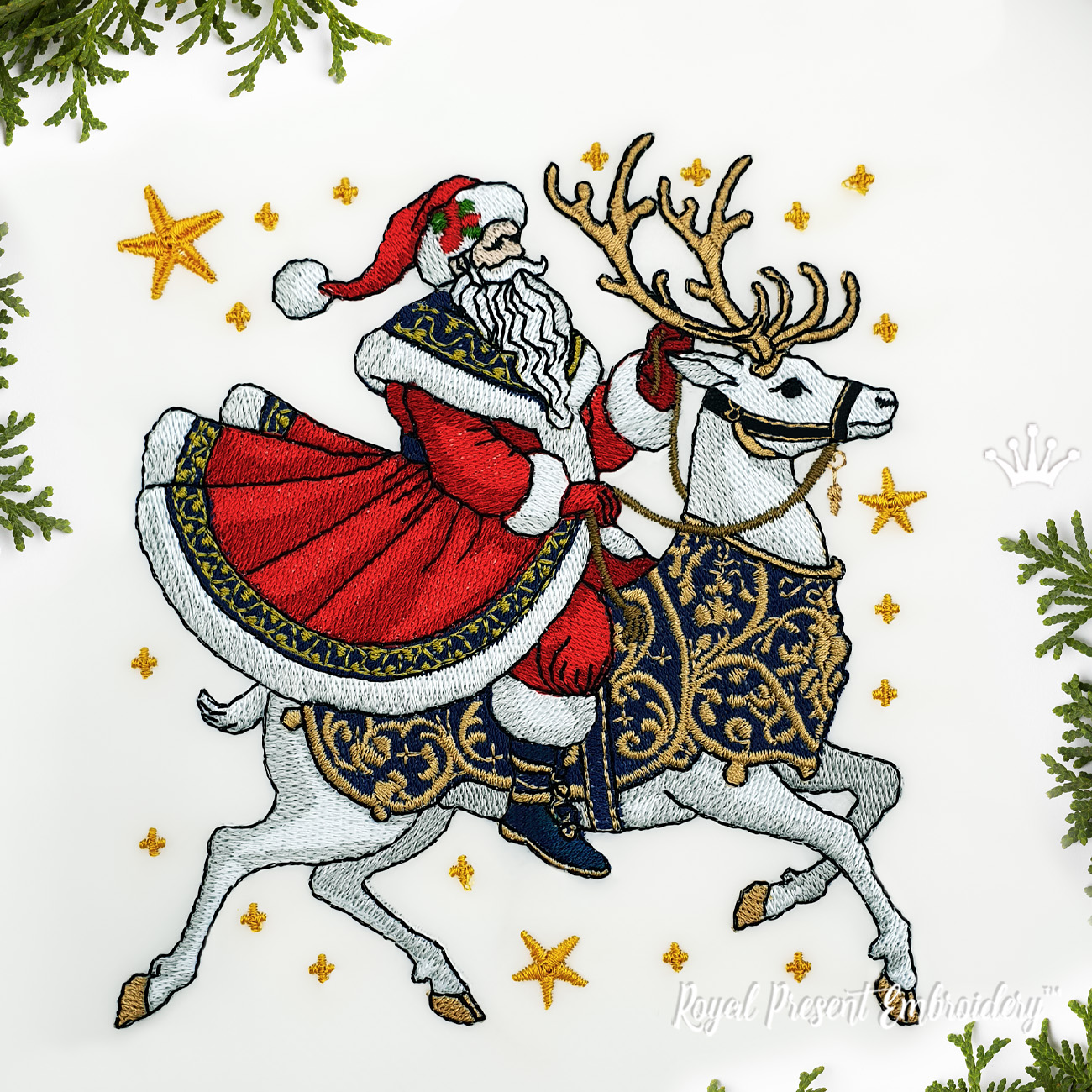
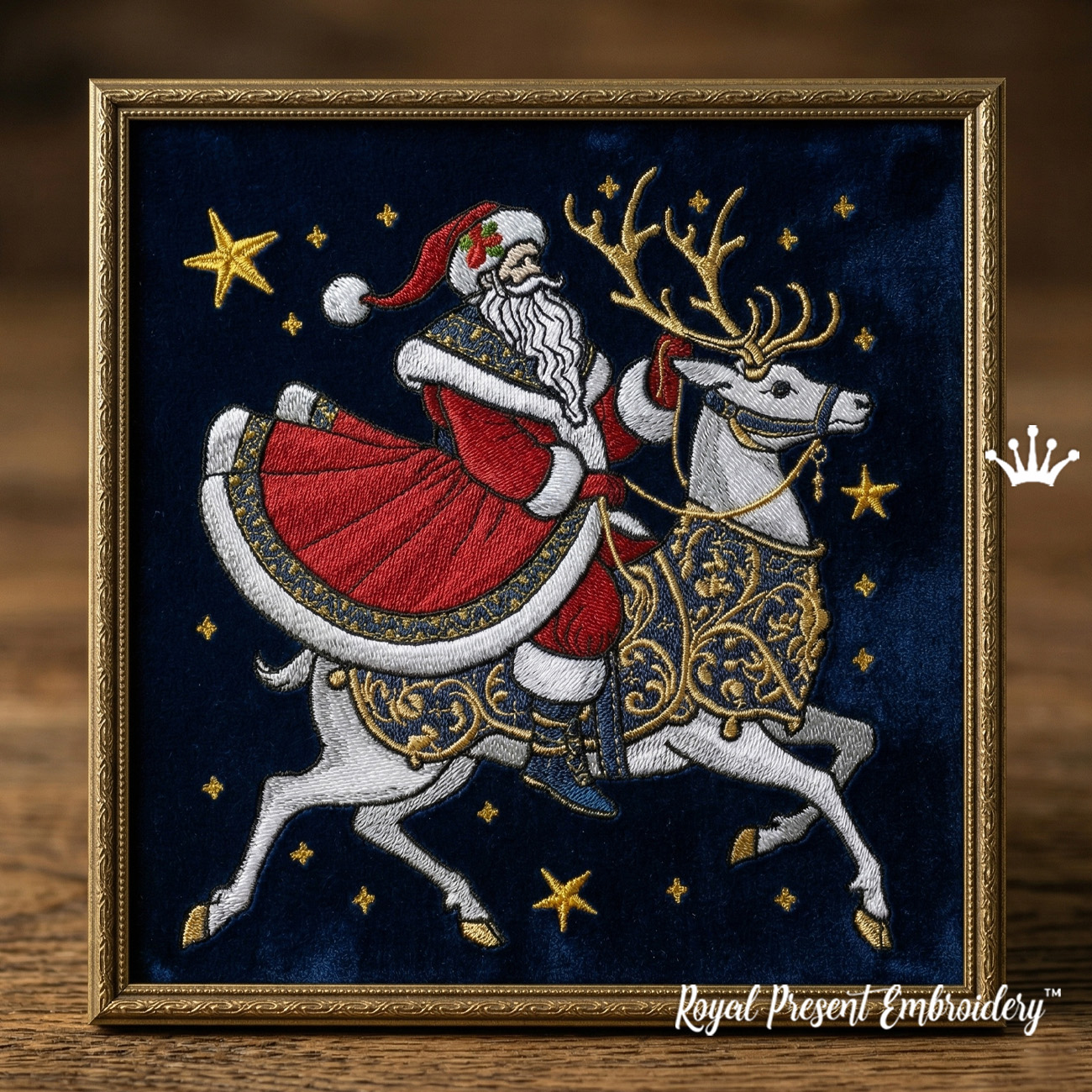
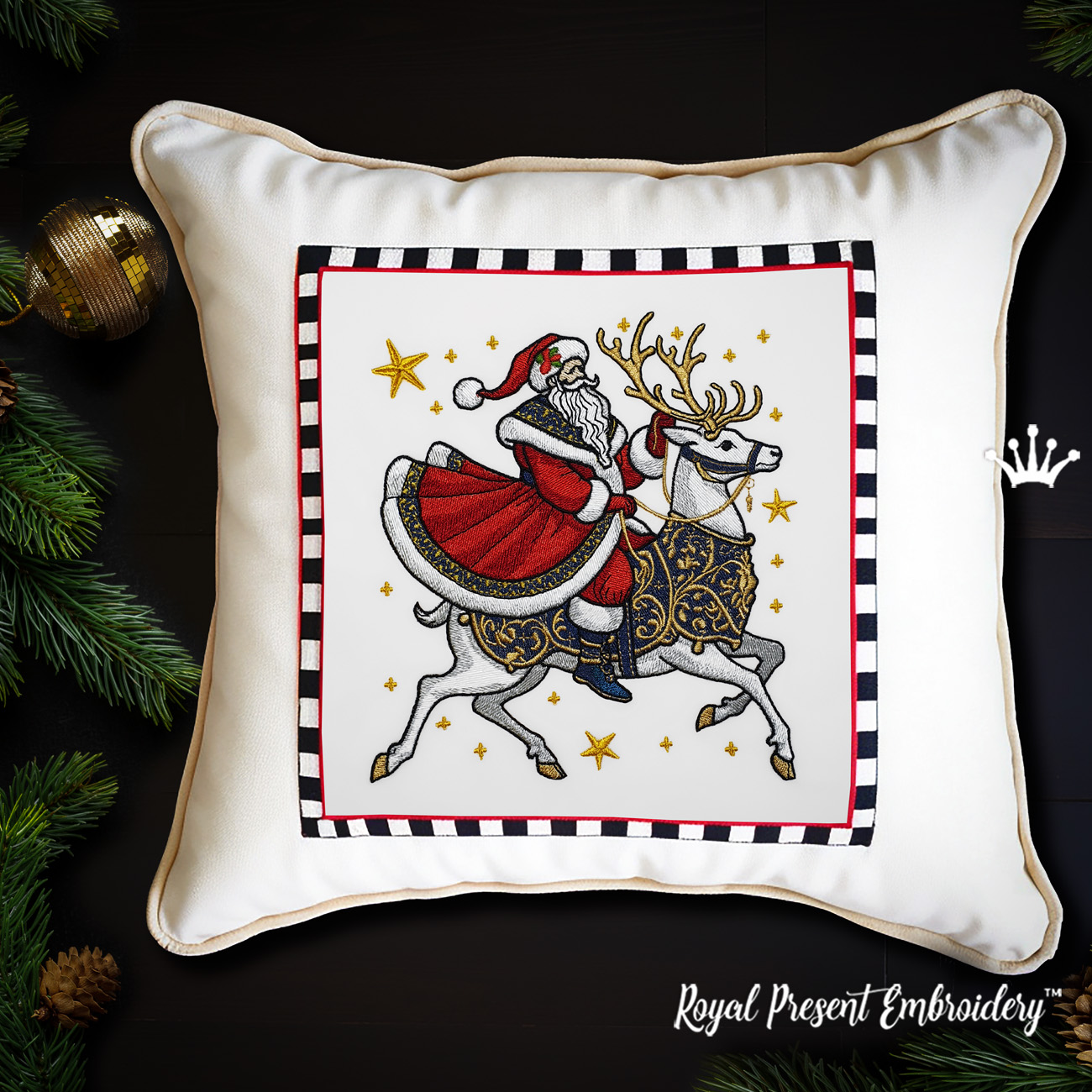
Fairytale Santa on a White Reindeer is a detailed Christmas machine embroidery design for festive linens, garments, quilt blocks and wall pieces. Santa’s red coat, the white reindeer, gold saddlework and small stars remain clear at every supplied size.
This is a digital download, not a finished item. Choose the file that matches your machine, unzip the archive, and stitch the design at its original scale.
Design Details
| Product type | Digital machine embroidery design |
| Motif | Santa riding a white reindeer with stars and ornate gold saddlework |
| Sizes | 4 |
| Minimum hoop | 130x180 mm (5x7 in) |
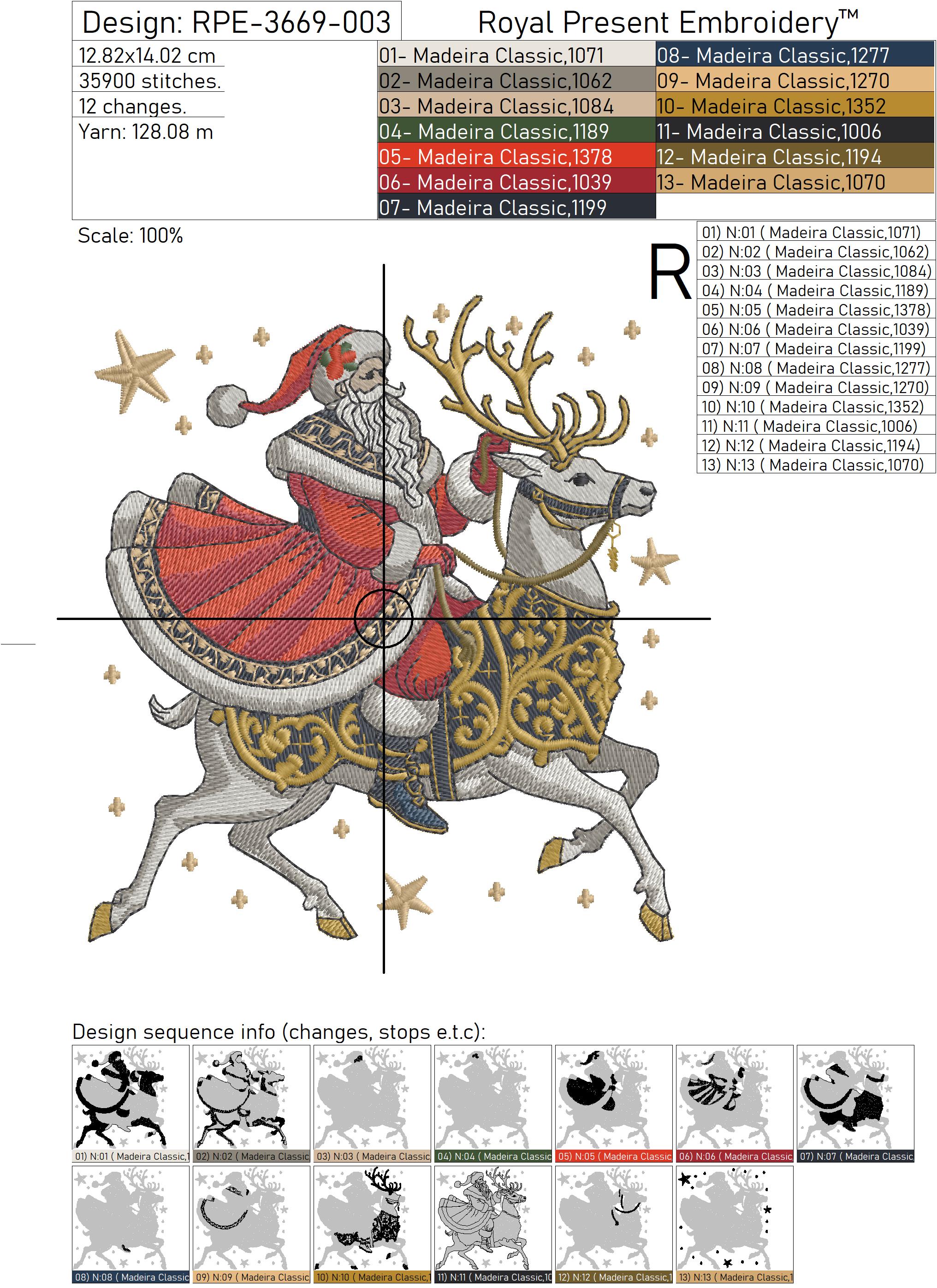
| Thread chart | 13 Madeira Classic color entries |
| Delivery | Instant digital download after purchase |
Sizes, Stitches and Hoops
| Exact design size and stitch count | Minimum compatible hoop |
|---|---|
| Size: 128.2x140.2 mm (5.05x5.52 "), Stitches: 35620 | 130x180 mm (5x7 in) |
| Size: 138.1x151.1 mm (5.44x5.95 "), Stitches: 39294 | 160x260 mm (6x10 in) |
| Size: 148.2x162.0 mm (5.83x6.38 "), Stitches: 43355 | 160x260 mm (6x10 in) |
| Size: 158.2x173.1 mm (6.23x6.81 "), Stitches: 47507 | 180x300 mm (7x12 in) |
Formats: .dst, .jef, .pec, .vip, .hus, .pes, .exp, .sew, .dat, .vp3, .xxx
Before the first stitch, open the file that matches your hoop and run the machine trace. Use the true embroidery field of your machine rather than the outside dimensions of the frame.
Madeira Classic Thread Chart
| Madeira Classic | Color swatch | |
|---|---|---|
| 1071 |
|
|
| 1062 |
|
|
| 1084 |
|
|
| 1189 |
|
|
| 1378 |
|
|
| 1039 |
|
|
| 1199 |
|
|
| 1277 |
|
|
| 1270 |
|
|
| 1352 |
|
|
| 1006 |
|
|
| 1194 |
|
|
| 1070 |
|
Choose the right fabric and hoop
The design contains dense areas and fine contours. A smooth, stable woven fabric gives the cleanest result: tightly woven cotton, twill, firm linen or a quilting-weight blend are suitable choices. Avoid a large print or a highly textured surface where the white reindeer and small dark lines could lose definition.
Use the hoop shown for the exact size row below. The four files are already proportioned for their intended hoop range; do not resize them in software.
Recommended Christmas designs


Stitching guidance
Stabilizer: For a stable woven base, use one medium cut-away stabilizer. As a working rule, divide the fabric weight by three: a 180 g/m² fabric (5.3 oz/yd²) needs at least about 60 g/m² (1.8 oz/yd²) of total stabilizer support. If the fabric flexes in the hoop or the design is stitched on loose linen, use two layers rather than tightening the thread.
Useful options: Madeira Cotton Soft is suitable as a tear-away layer under firm woven fabric; use two layers for open linen. Madeira Cotton Fix 9439 helps when a finished item is difficult to hoop. On pile, fleece, terry or velour, add a water-soluble topping such as Madeira Avalon Film or Sulky Solvy.
Frequently asked questions
How do I calculate the stabilizer weight for this design?
Use fabric weight ÷ 3 as a starting point for the total backing weight. For example, fabric weighing 180 g/m² gives approximately 60 g/m² of stabilizer. Choose the stabilizer type according to the fabric’s structure and stretch, then test this detailed design on the same material. The calculation is a starting point, not a fixed requirement for every fabric. See our stabilizer calculation and puckering guide.
How should I hoop the fabric to prevent puckering and shifted outlines?
Hoop the fabric and stabilizer together whenever the project allows. Keep both layers flat and secure without stretching the fabric, and do not pull the fabric edges after tightening the hoop. Use the smallest compatible hoop that accommodates your selected design size. Support the remaining fabric so its weight does not pull on the hoop during stitching. See our guide to hooping and preventing puckering.
Why use temporary spray adhesive, and where should I apply it?
Temporary embroidery adhesive helps prevent the fabric and stabilizer from shifting independently during stitching, which is especially useful for this design’s fine outlines. Apply a light, even coat to the stabilizer, away from the machine, then attach the fabric according to the adhesive manufacturer’s instructions. Adhesive helps hold the layers together; it does not replace stabilizer or secure hooping. Read our temporary spray adhesive guide.


 Get Sign-In Link
 Login with Google
 Login with Facebook
 Login with Amazon
 Login with Paypal