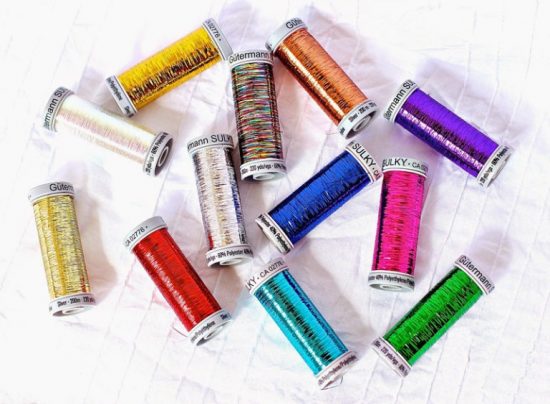
Gütermann SULKY SLIVER Metallic Thread, now listed by the European manufacturer as Gütermann creativ Sliver, is a flat, ribbon-like machine embroidery thread made to create a bright metallic effect. Unlike a conventional round metallic embroidery thread, Sliver reflects light from a broad, flat surface. That is why it can produce an unusually sharp flash on snowflakes, ornaments, monograms and decorative stitching.
This guide explains the correct name of the thread, its current technical specifications, the best needle and machine settings, how to prevent twisting and breaks, and how to use the small 200 m spool on home and commercial embroidery machines.
Quick answer
Use a metallic or topstitch needle in the NM 80–90 range, begin with NM 90/14, place the spool so that it can rotate and the flat ribbon unwinds without twisting, reduce upper tension gradually, and start at about 350–400 stitches per minute. Sliver works best in well-digitized designs without excessive density or many overlapping stitch layers.
Royal Present Embroidery sells digital machine embroidery designs. We do not sell thread, needles, stabilizers or other consumables. This article is an independent technical guide based on manufacturer specifications, specialist embroidery guidance and our own workshop experience.
Originally published November 22, 2016. Technically reviewed and updated July 24, 2026.
What is the correct name: Gütermann SULKY SLIVER or Gütermann creativ Sliver?
Both names can appear in searches, shops and older packaging:
- Gütermann SULKY SLIVER Metallic Thread is the familiar older retail name still used by many suppliers and embroiderers.
- Gütermann creativ Sliver is the current name shown on the European Gütermann website.
- Sulky Sliver Metallic Thread is the name used by Sulky in the United States, where the solid shades belong to the 8000 series.
The word is Sliver, not Silver. Sliver describes the narrow ribbon-like construction; it is not limited to the color silver. Depending on the market and product line, Sliver is available in gold, silver, copper, red, blue, green, black, opalescent and other shades.
The current Gütermann creativ Sliver product specification identifies it as a machine embroidery thread made with a fine metallic ribbon for smooth, uniform, shimmering embroidery.
Gütermann creativ Sliver technical specifications
| Current product name | Gütermann creativ Sliver |
|---|---|
| Older or regional name | Gütermann SULKY SLIVER Metallic Thread |
| Material | 60% polyester / 40% polyethylene |
| Construction | Fine, flat metallized ribbon or film rather than a conventional round embroidery yarn |
| Thickness | 40 / No. 175 |
| Recommended needle | Metallic machine embroidery needle or topstitch needle, NM 80–90 |
| Spool length | 200 m |
| Current listed range | 20 shades |
An important correction to older descriptions is the material composition. The current Gütermann specification for Sliver is 60% polyester and 40% polyethylene. The 60% polyamide / 40% polyester composition belongs to Gütermann creativ Metallic, a different thread. It should not be copied into a Sliver description.
Sliver should also not be described as containing absolutely no metal. It is more accurate to call it a metallized flat film or fine metallic ribbon. Sulky describes its Sliver film as metallized with aluminum. The practical distinction is that Sliver is not built like a conventional round thread made by wrapping metallic foil around a core.
Why Sliver reflects more light than round metallic thread
A round thread presents only a narrow curved surface to the light. Sliver presents a wider, flat reflective face. When the ribbon lies correctly on the embroidery surface, it creates a sharp mirror-like glint that can look brighter than an ordinary metallic thread of a similar color.
This optical advantage is also the thread's main technical challenge. If the flat ribbon twists before it reaches the needle, its reflective face changes direction. The embroidery can look uneven, and the twisted film is more likely to kink, shred or break. Correct thread delivery is therefore more important than simply increasing or decreasing tension.
Sliver versus conventional metallic thread
| Feature | Sliver | Round metallic | Holoshimmer |
|---|---|---|---|
| Construction | Flat solid-color metallized ribbon | Usually a round core with a metallic-effect wrap or bonded surface | Flat holographic ribbon |
| Light effect | Strong, clean flash from the flat face | More even sparkle around the thread | Rainbow or prismatic reflection |
| Main feeding issue | The ribbon must not twist | Kinking, abrasion and foil separation | The holographic ribbon must not twist |
| Best use | Snowflakes, ornamental lines, satin accents, lettering and decorative details | General metallic accents and designs digitized for metallic thread | Iridescent holiday, fantasy and decorative effects |
For a broader explanation of ordinary metallic threads, design density, stabilizer and thread lubricant, see our machine embroidery snowflakes and metallic thread guide.
Does Sliver protect the tension spring and thread guides?
The small wire that embroiderers often call the tension antenna is usually the upper-thread check spring, also called the take-up spring. On machines with an exposed tension assembly, the visible curled part may instead be a pigtail thread guide. Both sit in the upper thread path and can become wear points.
Some conventional metallic threads have a relatively hard foil-wrapped surface. At high speed or excessive tension, repeated movement can act like a fine saw and eventually form a groove in a thread guide or wear the check spring. In the Royal Present workshop, conventional metallic thread caused repeated problems with this part on a domestic embroidery machine.
Sliver has no coarse twisted wrap around a round core. When it is allowed to unwind flat and is stitched with lower tension and speed, it can pass through the upper path with less unnecessary rubbing. This is one reason it may behave more gently in a home machine. It is not, however, a guarantee against wear. A twisted ribbon, rough guide, burr, damaged needle or overly tight tension can still shred the thread and damage the thread path.
Is Sliver only for home embroidery machines?
No. The thread itself is not restricted to domestic machines. The important limitation is often the small 200 m consumer spool, not the thread material.
On a home embroidery machine, the reel normally fits a standard spool pin. On some commercial or industrial multi-needle machines, the thicker post on the thread stand is designed for large embroidery cones. The correct name for this part is the spool pin or spool post on the thread stand. If the center hole of the small Sliver reel is narrower than that post, the reel cannot be mounted directly.
Do not force the reel onto an oversized post and do not balance it loosely on top of a cone. Use a compatible auxiliary holder with a thin vertical spool pin, a felt pad and enough clearance for the reel to rotate freely. The ribbon should roll from the side of the spool and enter the first guide as flat as possible. A holder designed only to pull cone thread over the top can add twist and may be unsuitable unless it provides true flat, side-feed delivery.
Best machine settings for Gütermann SULKY SLIVER
- Install a new metallic or topstitch needle. Gütermann specifies NM 80–90. For most medium-weight embroidery projects, NM 90/14 is the safest starting point because its larger, elongated eye reduces rubbing. Test NM 80/12 only when the fabric requires a finer needle and the ribbon passes cleanly.
- Use a vertical spool pin with a felt pad. The spool must rotate so the flat ribbon rolls from its side. The felt pad controls overspin without stopping the reel.
- Check the first 20–30 cm of the thread path. Watch the ribbon as you pull it by hand. If it turns into a narrow spiral before entering the tension area, change the spool orientation or holder.
- Thread the machine with the presser foot raised. This opens the upper tension discs and helps the thread seat correctly.
- Reduce upper tension gradually. Sulky suggests lowering top tension more for Sliver than for its round Original Metallic thread, often by two or three numbers on machines with a numbered scale. Treat that only as a starting point because tension scales differ by machine.
- Start slowly. Begin at approximately 350–400 stitches per minute. If the machine cannot be set that low, reduce it to roughly half of its normal embroidery speed.
- Use normal polyester bobbin thread. Sliver in the bobbin is unnecessary for ordinary fabric embroidery. Use it in both top and bobbin only for a carefully tested special project such as freestanding lace where both sides must match.
- Run a complete test. Use the same fabric, stabilizer, needle, thread, design size and machine settings planned for the final item.
Sulky gives additional product-specific setup advice in its Sliver and metallic thread technical FAQ, including vertical spool placement, tension reduction and 90/14 needle guidance.
Which embroidery designs work best with Sliver?
Sliver gives the best result when the design leaves the thread enough room to lie flat. Suitable designs usually have clear paths, moderate density and no unnecessary stacks of underlay, fill and outline stitches in the same place.
- snowflakes, stars and winter ornaments;
- open filigree and decorative linework;
- moderate-width satin-stitch borders and monogram accents;
- small highlights inside a design stitched mainly with rayon or polyester;
- freestanding lace that has been tested specifically with metallic-effect thread.
Be cautious with very dense fills, tiny lettering, repeated short stitches, sharp backtracking and areas where several stitch layers cross. A design that repeatedly breaks Sliver at exactly the same coordinate usually has a digitizing or density problem, not a spool problem.
Can silicone spray or thread lubricant help?
A dedicated embroidery-thread lubricant can help when a correctly positioned spool, fresh needle, lower tension and slower speed have not completely solved shredding. Gunold Silicone Spray 610 and Sulky Silicone Spray are marketed for reducing friction with rayon and metallic threads.
Use only a product intended for embroidery thread and follow its label. Apply a light amount to the spool if the manufacturer instructs you to do so. Never spray a general-purpose household lubricant, WD-40 or silicone product into the embroidery machine, tension discs or hook area. Check the machine manual or dealer guidance before using any lubricant, especially while the machine is under warranty.
Lubricant cannot repair a burred needle plate, damaged guide, worn check spring or incorrect thread path. If breaks continue at random points, inspect every surface the thread touches.
Troubleshooting Sliver thread breaks and poor shine
| Symptom | Likely cause | What to change |
|---|---|---|
| Ribbon shreds near the needle | Needle eye too small, damaged needle, excessive speed or tension | Fit a new NM 90/14 metallic or topstitch needle, slow to 350–400 spm and reduce top tension in small steps |
| Thread breaks at random places | Twisted ribbon, spool snag, rough guide, lint or a burr | Correct spool orientation, clean the thread path and inspect every guide and contact point |
| Thread breaks at the same stitch every time | Excessive density, very short stitches or overlapping paths | Inspect the stitch file; choose another design section, revise the digitizing or use standard embroidery thread there |
| Shine looks dull or striped | The flat ribbon is twisting, so its reflective face changes direction | Reposition the spool and holder so the ribbon rolls off flat and stays flat before the tension area |
| Loops appear on top | Upper tension is too low, thread is not seated in the discs or the spool is overspinning | Rethread with the presser foot raised, use the felt pad and increase tension slightly |
| Small reel will not fit a commercial thread stand | The industrial spool post is wider than the reel's center hole | Use a thin auxiliary spool pin or compatible adapter that lets the reel rotate and side-feed without twisting |
Machine embroidery snowflake designs for Sliver thread
Snowflakes are especially effective with flat reflective thread because long radiating elements catch the light from different directions. The designs below link directly to their product pages in the Royal Present Embroidery store.
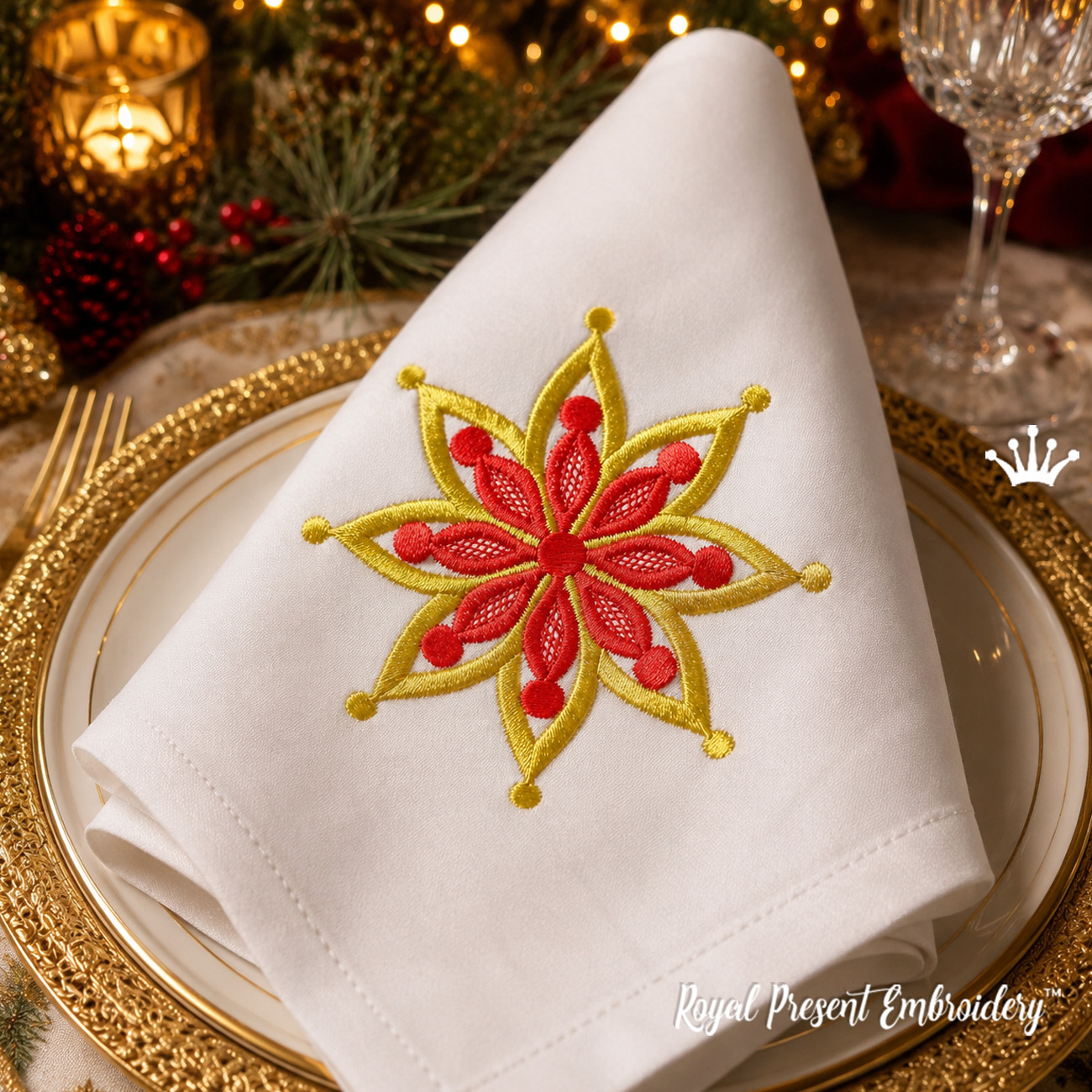
Sparkling Christmas Snowflake Machine Embroidery Design - 3 sizes
This is the original snowflake image used in this article. The product includes three sizes: 99.2 × 99.2 mm, 118.4 × 118.2 mm and 139.6 × 139.6 mm. The smallest version fits a full 100 × 100 mm embroidery field.
Vintage Snowflake Machine Embroidery Design for Christmas Towels - 3 Sizes
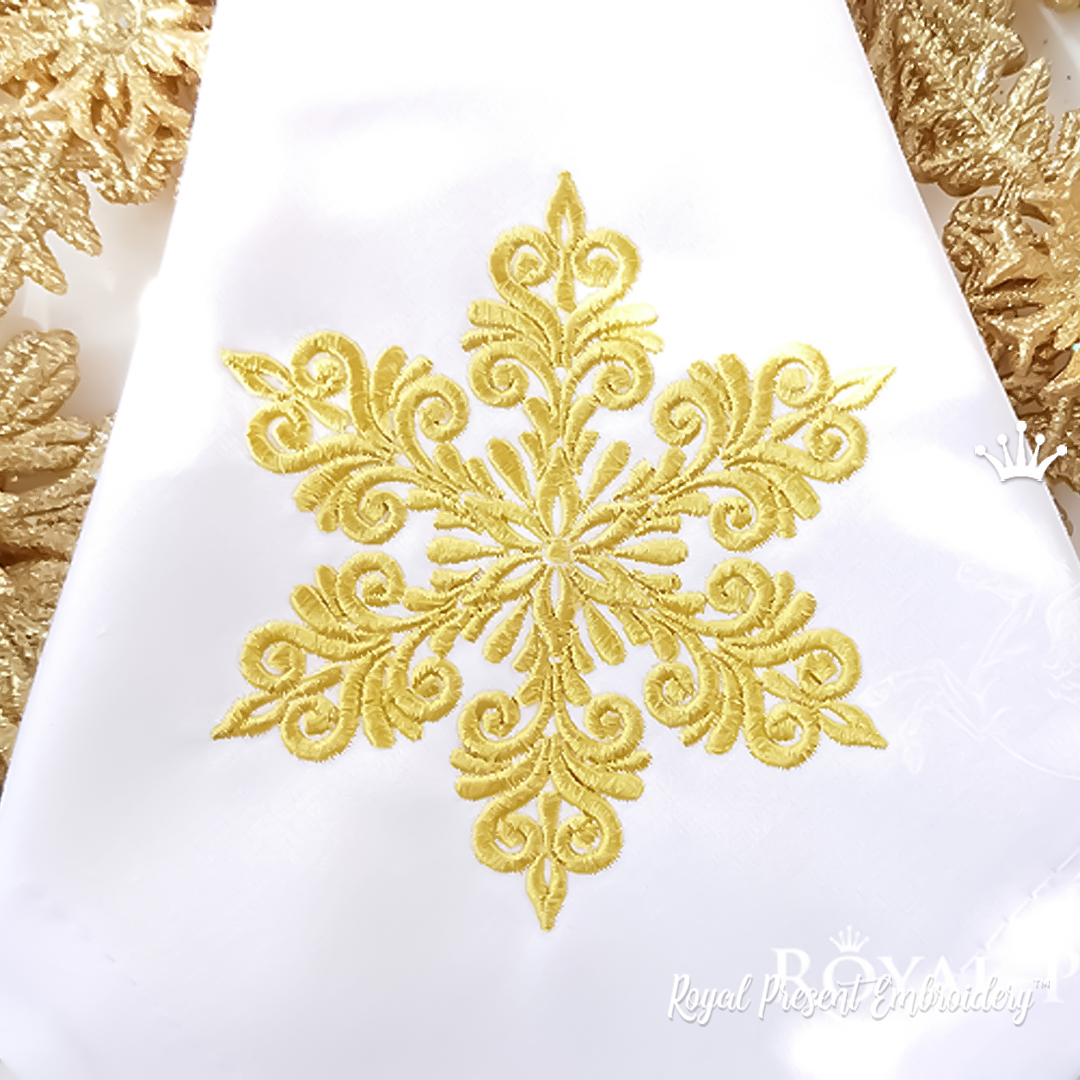
Gold Swirl Christmas Snowflake Machine Embroidery Design - 4 sizes
Royal Present workshop recommendation
Sliver is not a universal replacement for rayon, polyester or every conventional metallic thread. It is a special visual tool. Use it where the flat reflective face contributes to the design, and switch back to standard embroidery thread in dense areas that do not need a mirror-like flash.
The three most important variables are not brand slogans but mechanics: the ribbon must enter the machine flat, the needle eye must be large and smooth enough, and the design must give the ribbon space to lie without being repeatedly perforated. When those conditions are correct, Sliver can produce clean, bright embroidery with far fewer breaks.
This guide was prepared by Ludmila Konovalova, founder and machine embroidery designer at Royal Present Embroidery.
Frequently asked questions
Is it called Sliver or Silver thread?
The product name is Sliver. Silver is only one possible color. Sliver refers to the narrow, flat ribbon-like thread construction.
What is the current official name?
The current European Gütermann name is Gütermann creativ Sliver. Older packaging and many retailers use Gütermann SULKY SLIVER Metallic Thread, while the US Sulky line uses Sulky Sliver Metallic Thread.
What needle should I use for Gütermann Sliver?
Gütermann specifies a metallic machine embroidery needle or topstitch needle in the NM 80–90 range. NM 90/14 is a practical first test for most medium-weight embroidery projects.
What speed should I use?
Start at approximately 350–400 stitches per minute or about half the machine's normal embroidery speed. Increase the speed only after the ribbon feeds flat and stitches without shredding.
Can I use Sliver on an industrial or multi-needle embroidery machine?
Yes, the thread itself can be used, but the small 200 m reel may not fit a thick commercial cone post. Use a compatible auxiliary spool holder or adapter that allows the reel to rotate and the ribbon to feed from the side without twisting.
Should I put Sliver in the bobbin?
For ordinary fabric embroidery, use normal polyester bobbin thread. Sliver in both the top and bobbin is mainly useful for a tested special project, such as freestanding lace, where both sides need the same metallic effect.
Why does Sliver keep breaking at the same point?
A repeated break at the same coordinate usually indicates excessive stitch density, overlapping paths or very short stitches. Changing the spool or tension may not solve a design-file problem.

Author: Ludmila Konovalova
My name is Ludmila Konovalova, and I lead Royal Present Embroidery. Embroidery for me is more than a profession; it is a legacy of my Ukrainian and Bulgarian heritage, where every woman in my family was a virtuoso in cross-stitch and smooth stitching. This art, passed down through generations, is part of my soul and a symbol of national pride.
Date: 01.11.2025

 Get Sign-In Link
 Login with Google
 Login with Facebook
 Login with Amazon
 Login with Paypal