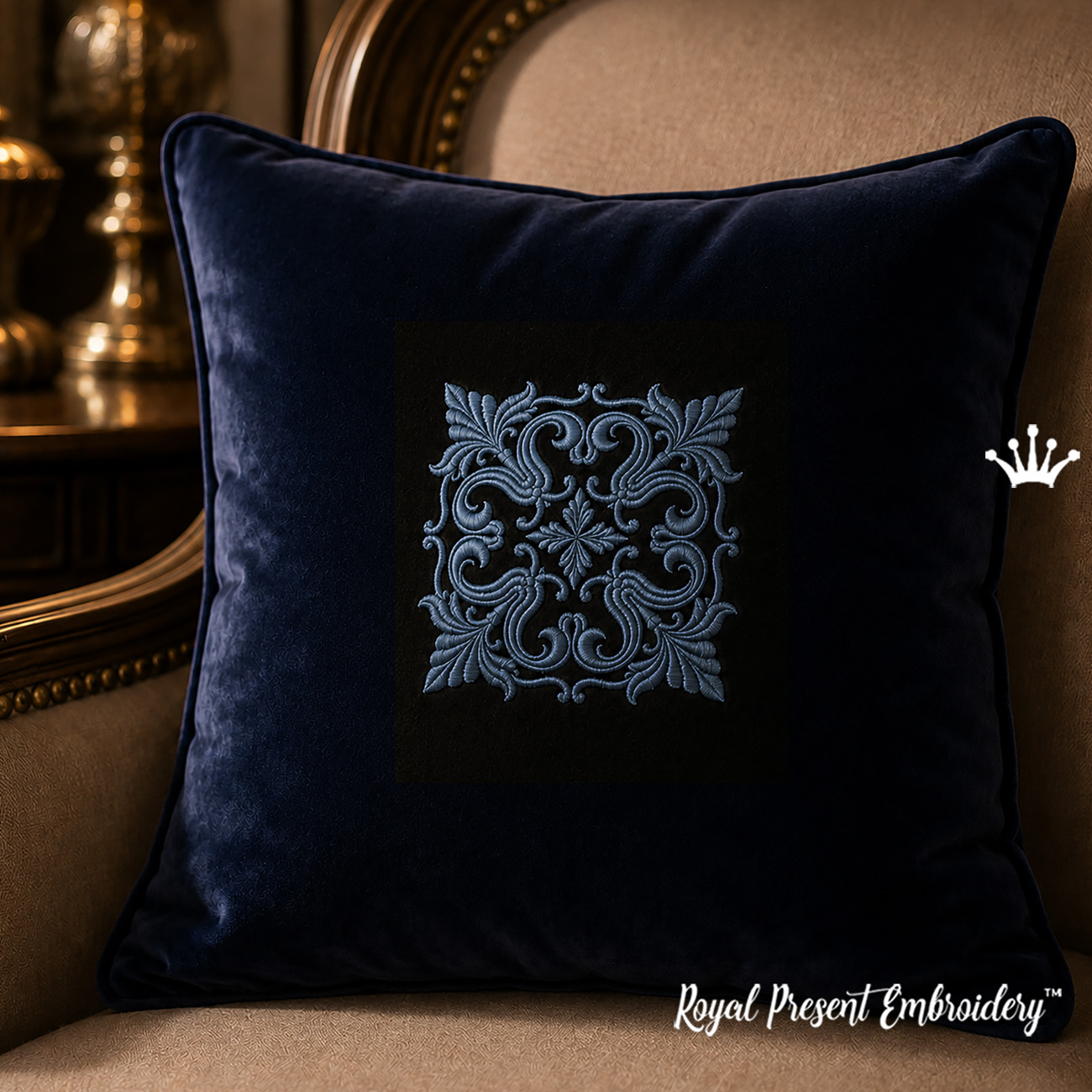
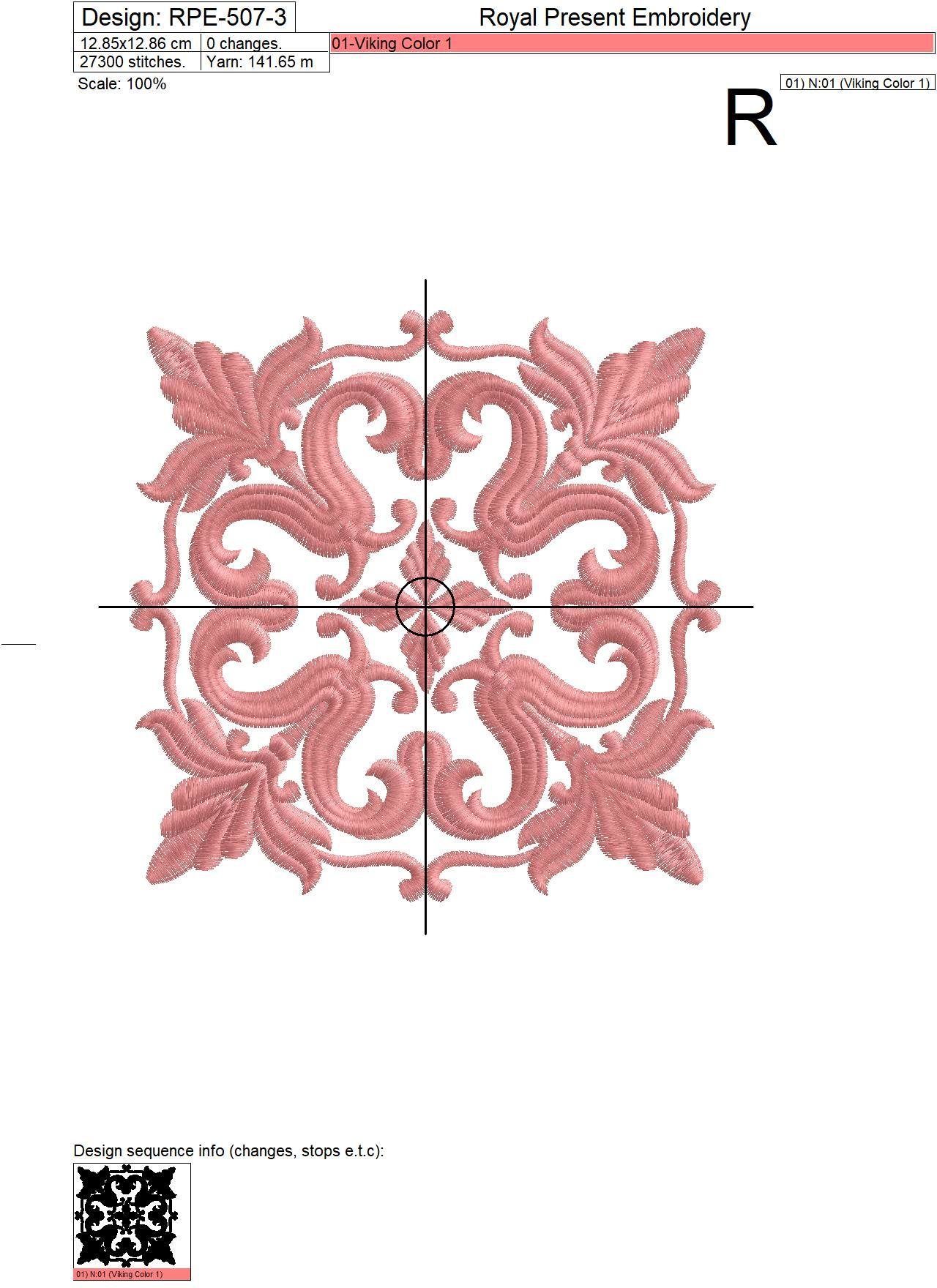
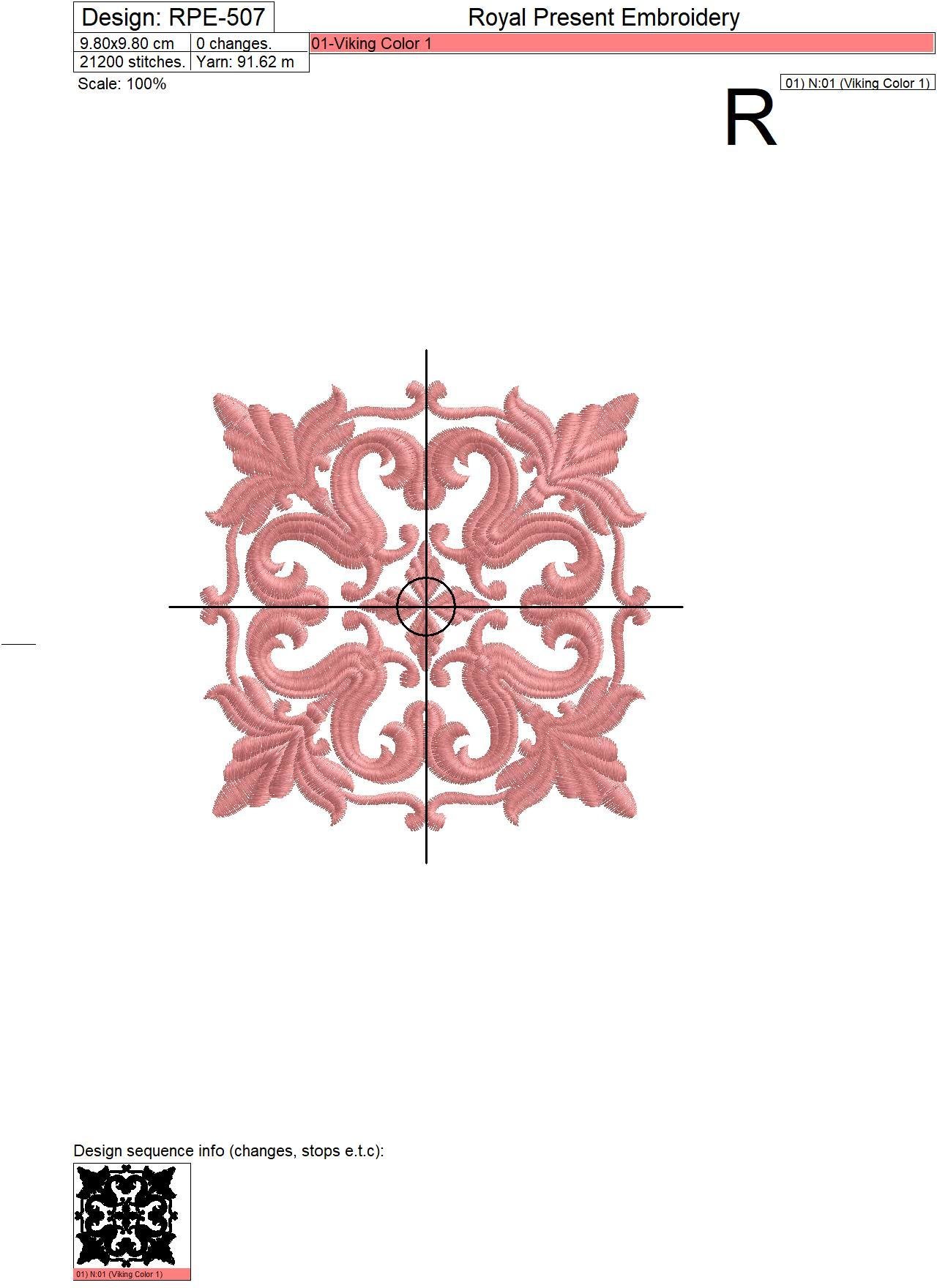
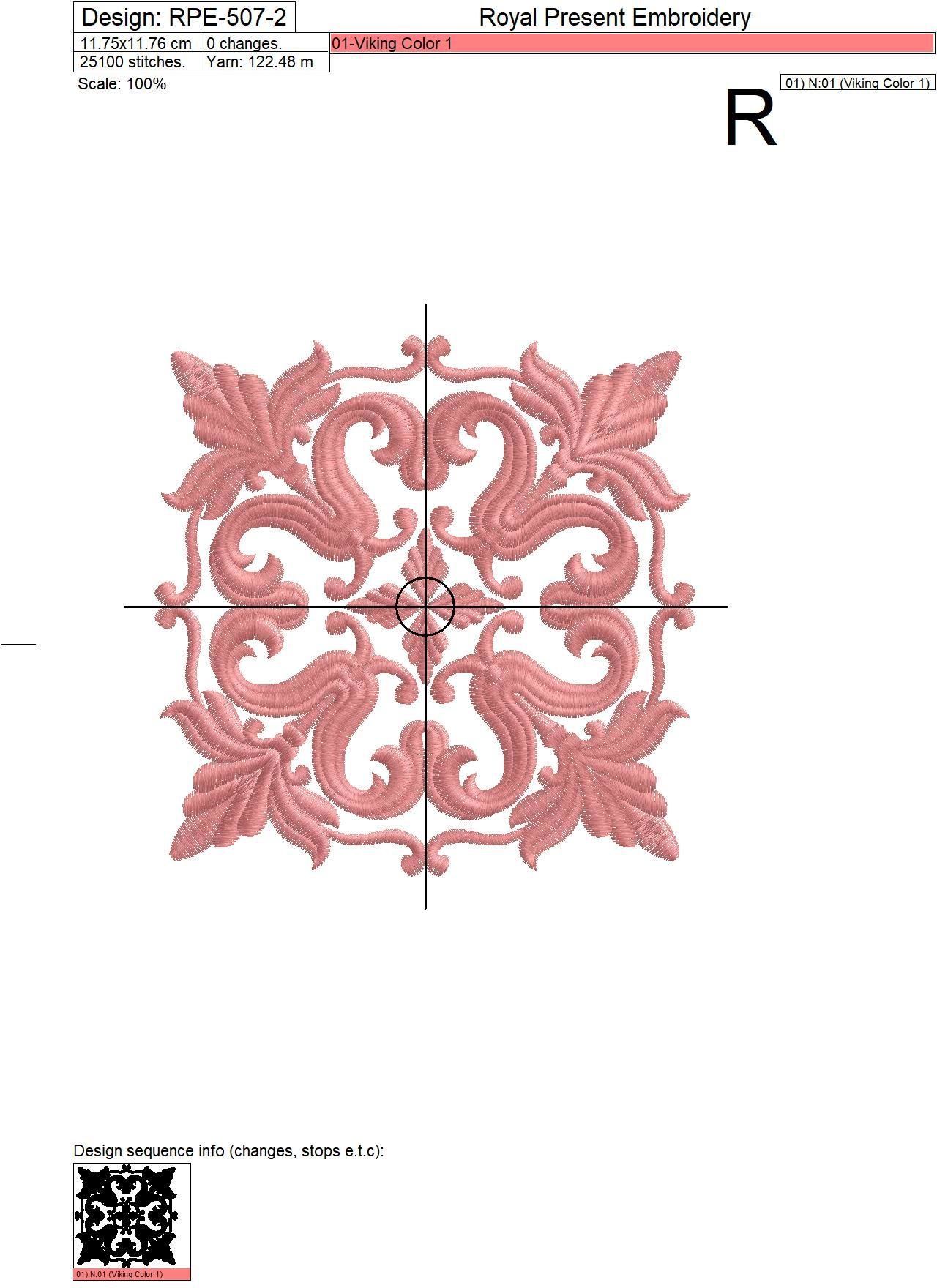
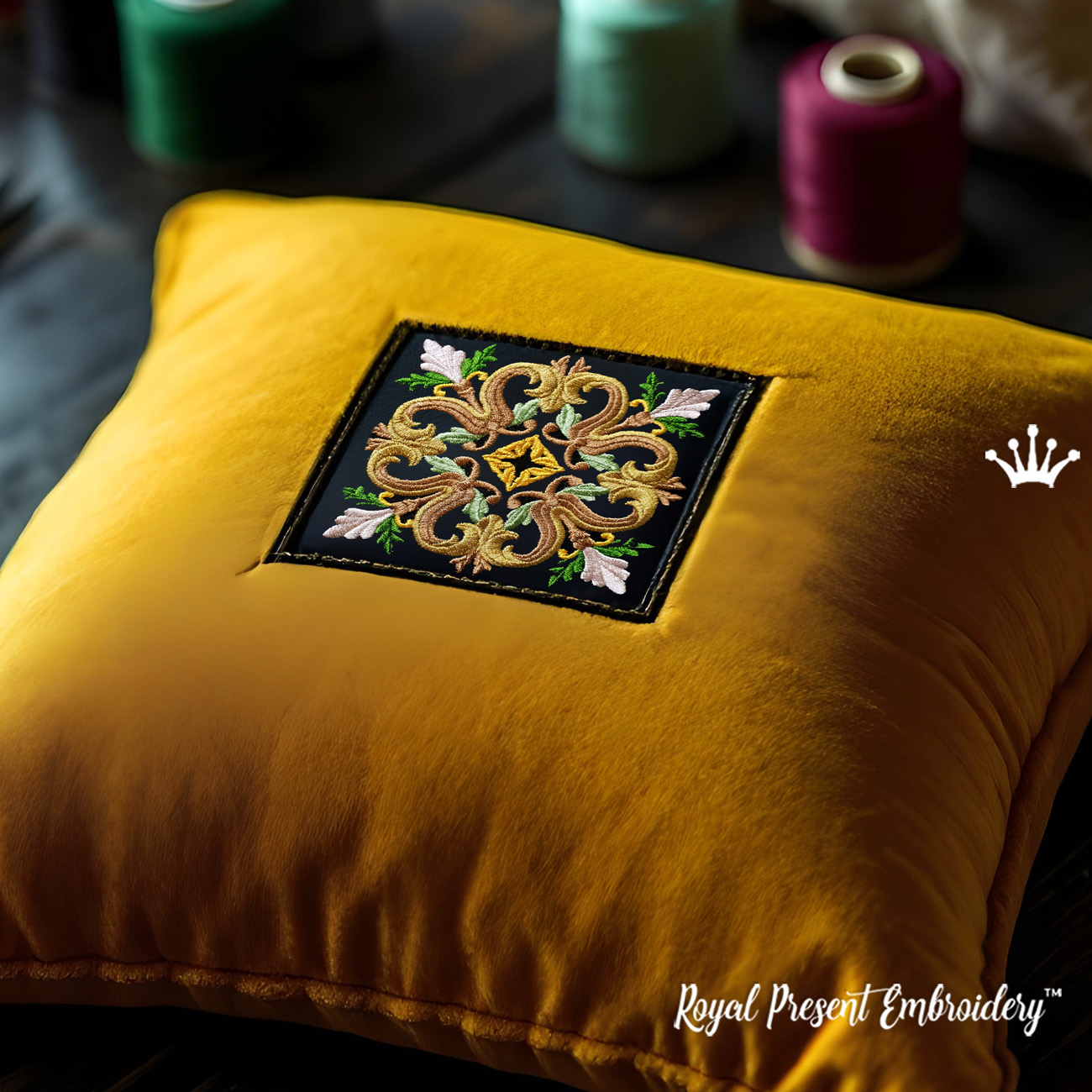
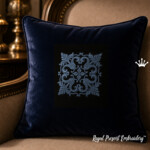
Acanthus Quilt Block is a one-color machine embroidery design built as a symmetrical botanical square. Curved acanthus leaves surround a small central rosette, while four corner palmettes give the motif a clear modular outline.
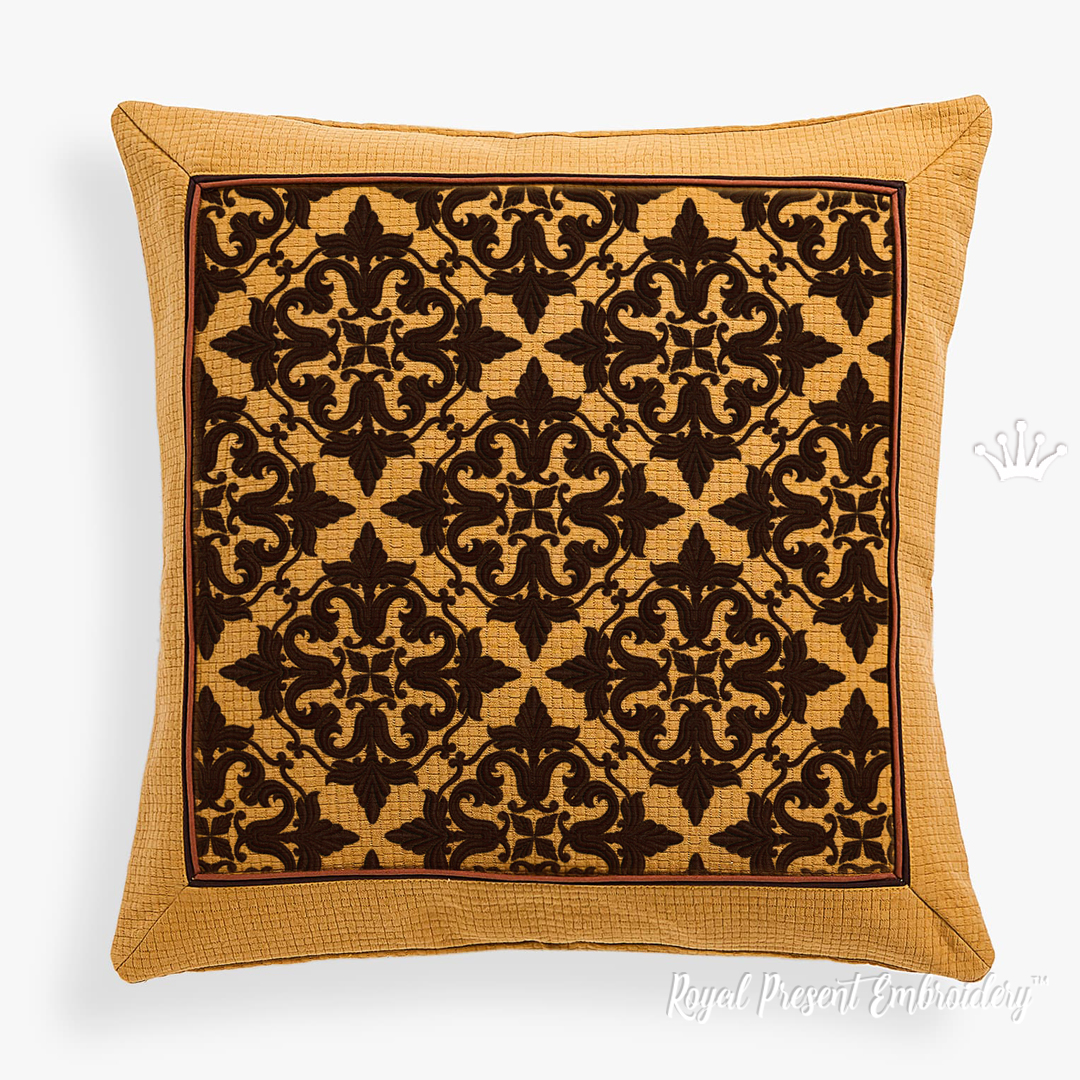
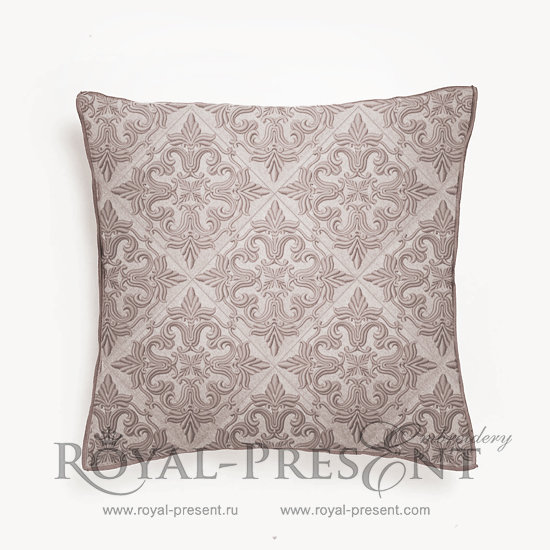
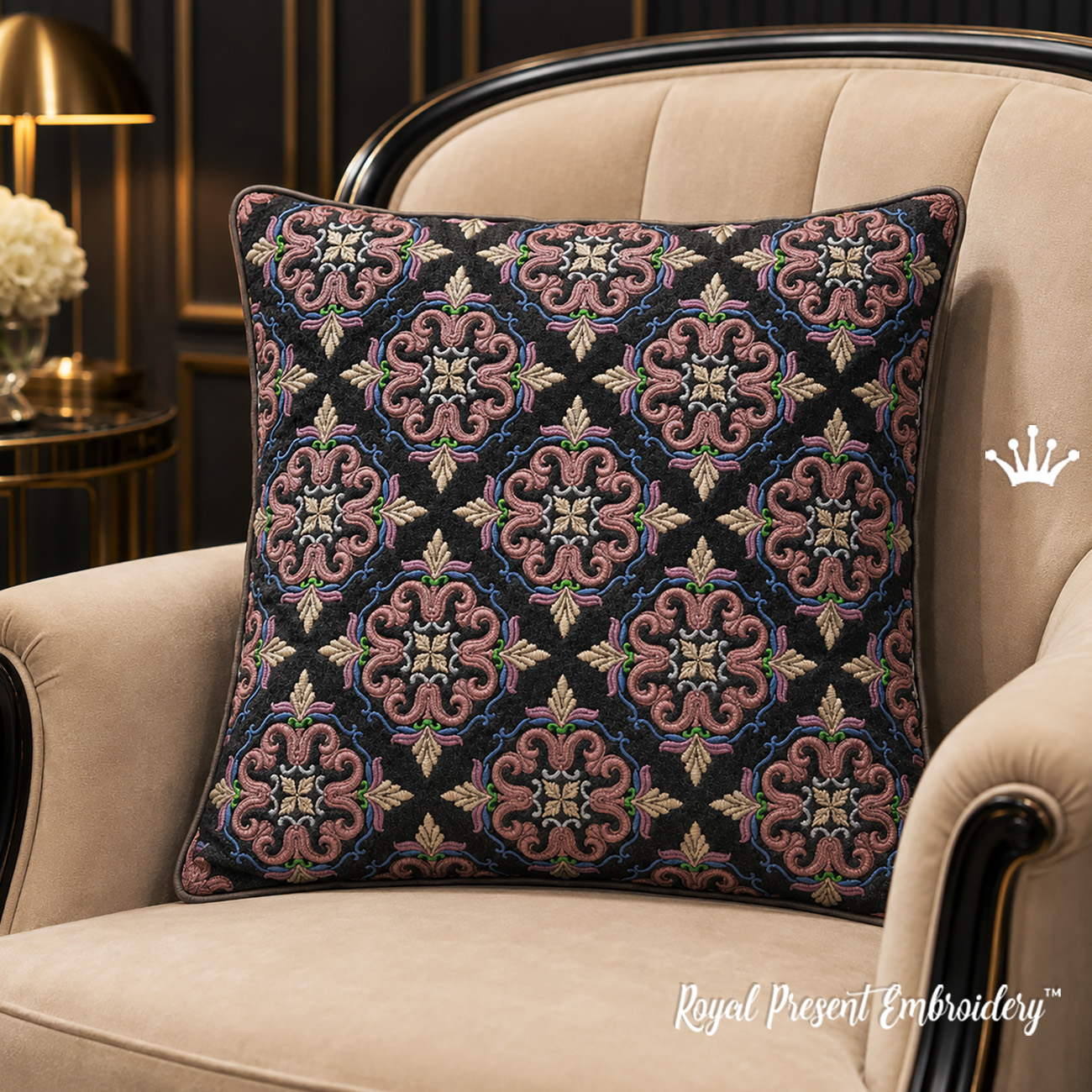
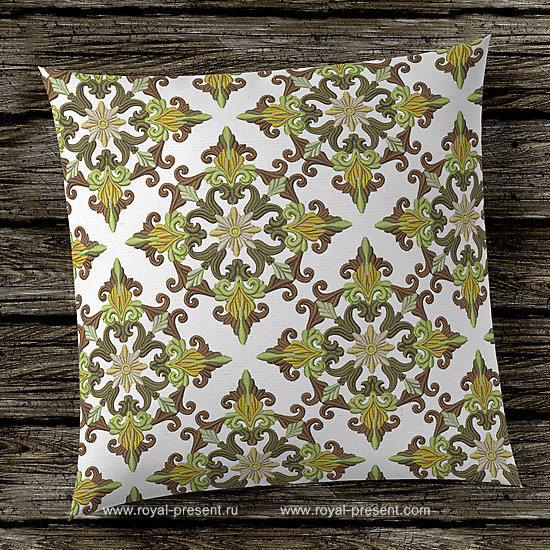
Stitch one block as a formal medallion or repeat identical squares for patchwork cushions, quilts and textile panels. When the blocks are placed closely together, neighboring corner leaves create a secondary diamond pattern between the central ornaments.
You are purchasing digital files for an embroidery machine. Fabric, thread, stabilizer, a finished cushion and the editable source file are not included.
Size: 98.5x98.5 mm (3.88x3.88 "), Stitches: 30837
Size: 117.5x117.5 mm (4.63x4.63 "), Stitches: 36201
Size: 128.4x128.5 mm (5.06x5.06 "), Stitches: 39417
Formats: dst, jef, pec, vip, hus, pes, sew, exp, dat, vp3, xxx
What Is Included
- one square acanthus motif in three prepared sizes;
- a compact file for a 100 × 100 mm / 4x4 embroidery field;
- two larger files for a field of at least 130 × 180 mm / 5x7;
- dst, jef, pec, vip, hus, pes, sew, exp, dat, vp3 and xxx machine formats;
- decorative embroidery only, without fabric cutting lines, seam allowances or automatic ITH cushion assembly.
Design Sizes, Stitch Counts and Hoops
| Design size |
Stitches |
Minimum embroidery field |
Practical hoop choice |
98.5 × 98.5 mm
3.88 × 3.88 inches |
30,837 |
at least 98.5 × 98.5 mm |
100 × 100 mm / 4x4 |
117.5 × 117.5 mm
4.63 × 4.63 inches |
36,201 |
at least 117.5 × 117.5 mm |
130 × 180 mm / 5x7 |
128.4 × 128.5 mm
5.06 × 5.06 inches |
39,417 |
at least 128.4 × 128.5 mm |
130 × 180 mm / 5x7, after tracing the boundary |
The largest file fits a 130 × 180 mm field with only 1.5 mm of total clearance on its 128.5 mm side. That is approximately 0.75 mm at each edge when perfectly centered. Attach the intended hoop and run the machine's boundary trace before stitching.
One Medallion or a Repeated Pattern
| Motif size and layout |
Blocks |
Embroidered field without gaps |
Total stitches |
| 98.5 mm — 2 × 2 |
4 |
197.0 × 197.0 mm
7.76 × 7.76 inches |
123,348 |
| 117.5 mm — 2 × 2 |
4 |
235.0 × 235.0 mm
9.25 × 9.25 inches |
144,804 |
| 128.4 × 128.5 mm — 2 × 2 |
4 |
256.8 × 257.0 mm
10.11 × 10.12 inches |
157,668 |
These figures describe the embroidery footprints placed directly beside one another. For pieced patchwork, embroider on oversized fabric squares, allow the stabilized fabric to relax, square every block with the same template and then add the required seam allowance.
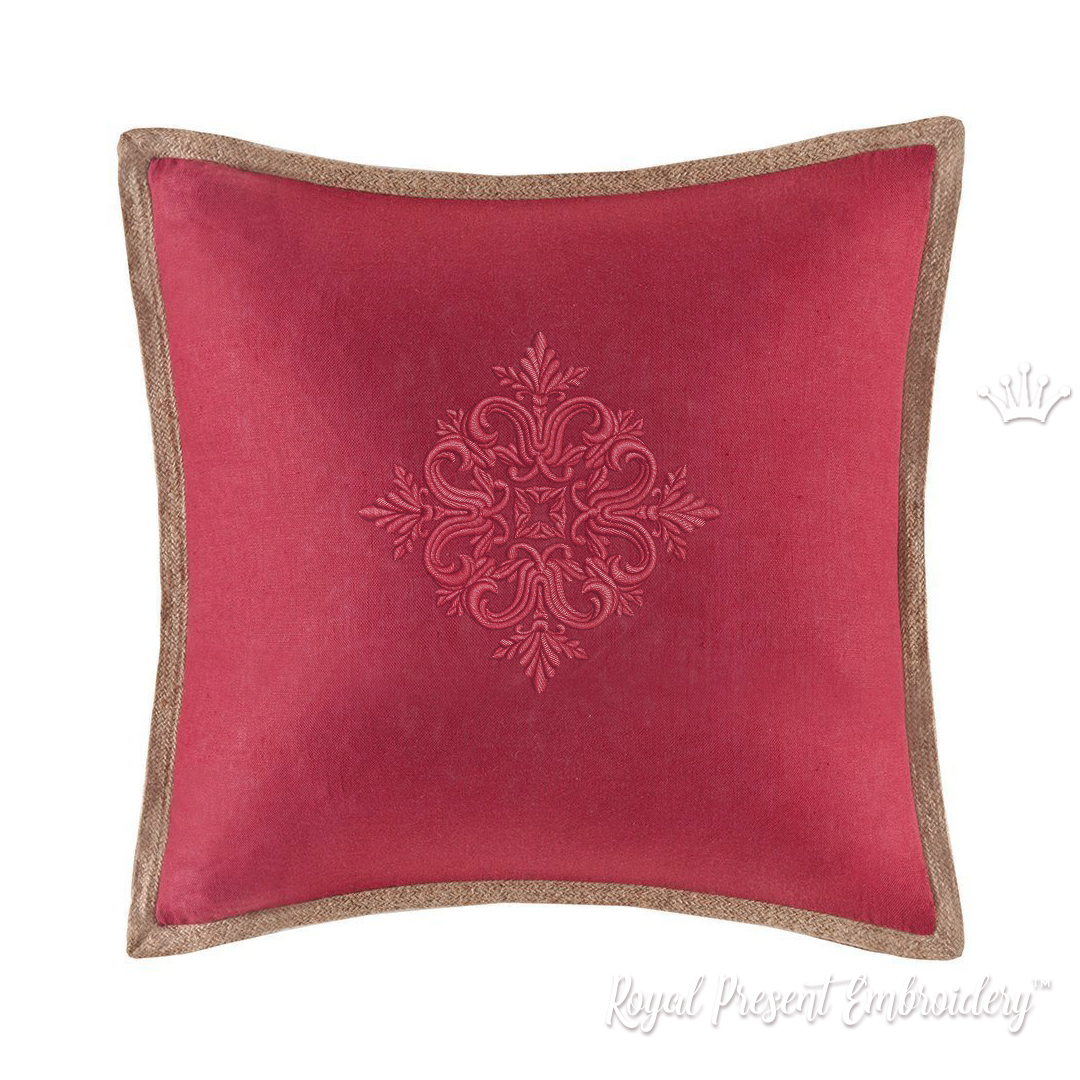
One block in the center
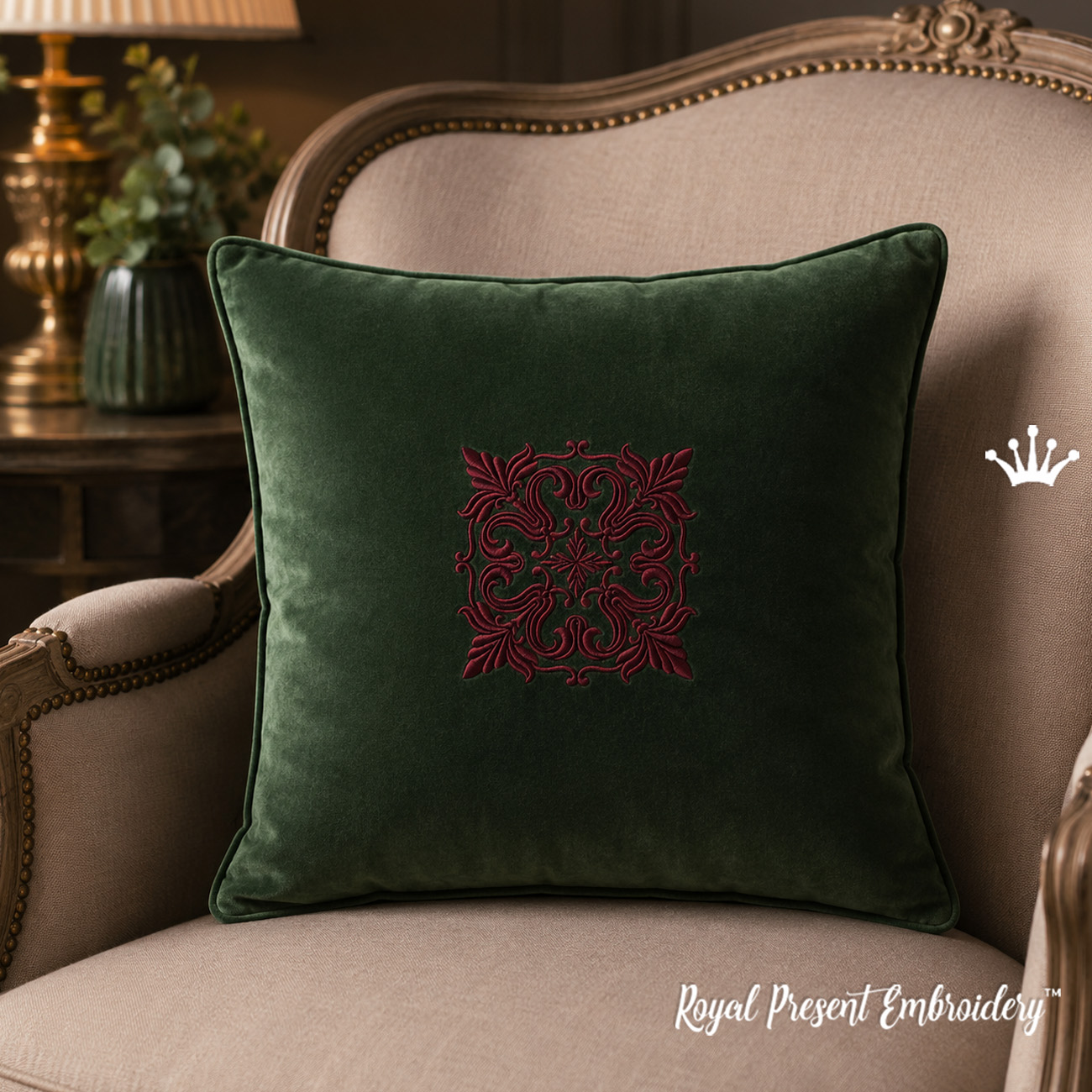
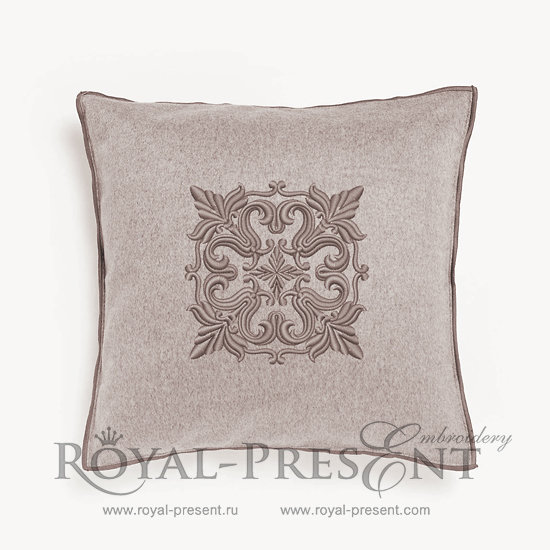
The largest motif works as a formal medallion on a 40–45 cm cushion front. A generous plain margin keeps the detailed scrollwork readable and shows the relief especially well on velvet, satin or firm linen.
Repeat without rotation
Keep every block in the same orientation and align the horizontal and vertical centerlines. The corner palmettes form a regular secondary diamond network while the central ornaments retain one direction.
Rotate neighboring blocks by 90 degrees
A quarter-turn creates a more dynamic surface, but it also rotates the fill-stitch direction. The same thread can appear lighter or darker from one block to the next, particularly with rayon thread on satin or velvet.
One-Color Embroidery and Thread Choice
The design is intended as a one-color ornament, so no machine stop is needed for decorative color changes. Because the available PRE-507 stitch chart uses a generic Viking Color 1 label, it does not identify a Madeira shade number.
- Formal contrast: burgundy on dark green, navy or black fabric.
- Light interior palette: taupe, champagne or antique gold on ivory fabric.
- Tonal embroidery: choose thread one or two values lighter than the fabric and let the stitch direction create the visible pattern.
For a multi-block panel, use spools from the same dye lot and record the selected Madeira Classic or Madeira Polyneon number before starting. A slight shade difference that is invisible on one block can become obvious across a repeated surface.
Stitching on Velvet and Stable Fabrics
- Velvet and velour: hoop a firm cut-away stabilizer, float the fabric with temporary adhesive and secure it with a basting frame instead of crushing the pile in the hoop.
- Top layer: add a thin water-soluble film so narrow scroll tips and leaf edges do not sink into the pile.
- Cotton and linen: hoop the fabric together with medium-weight cut-away stabilizer; test loose linen before committing to the final block.
- Needle: begin with a fresh embroidery needle 75/11 and standard 40-weight thread; test 80/12 on heavy interior fabric.
- Speed: begin around 500–600 stitches per minute and watch the long satin curves for thread breaks or distortion.
Remove water-soluble topping in small sections after stitching instead of pulling across the scrollwork. Lift residue beside dense edges with a slightly damp cotton swab.
Related Acanthus and Botanical Quilt Blocks
Explore more traditional square motifs in Classic Quilt Style and browse the wider Quilt Blocks machine embroidery collection.
Frequently Asked Questions
Which file fits a 4x4 hoop?
Use the 98.5 × 98.5 mm / 3.88 × 3.88 inch file. It leaves only 1.5 mm of total clearance on each axis inside a true 100 × 100 mm field, so trace the boundary before stitching.
Do both larger files fit a 5x7 hoop?
Yes, when the machine provides a true 130 × 180 mm embroidery field. The 128.4 × 128.5 mm file is a close fit on the short side and should be checked directly with the intended hoop attached.
Is the design really one color?
Yes. The motif is digitized as one continuous color sequence. Choose any thread shade that gives enough contrast against the fabric; Viking Color 1 is not a Madeira shade number.
Is this a seamless edge-to-edge pattern?
No. Each motif has its own completed outer contour. Close repetition produces a visually continuous network, but neighboring blocks do not share connected stitches.
Can I stitch several blocks on one piece of fabric?
Yes, if you can mark centers accurately and rehoop without cumulative drift. Separate oversized squares are usually easier to embroider, square and join as patchwork on a domestic machine.
Is this a quilting stitch design?
No. It is decorative machine embroidery and does not replace the structural quilting that holds the quilt top, batting and backing together.
Can I resize the largest file on my machine?
Simple coordinate scaling may change stitch density and satin-column width. First use one of the three prepared sizes in the ZIP archive. If another dimension is required, read the design resize service instructions.
Digital Product and Usage
After payment, the buyer receives prepared machine embroidery formats. The editable source file remains with the designer and is not included. You may use the design for personal projects and limited small-business production of finished embroidered goods. The digital files may not be copied, shared, traded, published or resold. Mass industrial production is not permitted under the standard license.
Designer: Ludmila Konovalova, Royal Present Embroidery.

 Get Sign-In Link
 Login with Google
 Login with Facebook
 Login with Amazon
 Login with Paypal