Fir Branch with Carrots and Red Bows Embroidery Design - 4 Sizes
By knowing the speed of your embroidery machine, you can find out how long it will take to embroider a design.
To use the embroidery calculator, click on the number of stitches in the product description.
Fir Branch with Carrots and Red Bows is one digital machine embroidery design supplied in 4 sizes. After purchase, you receive ready-to-stitch files in the machine formats listed below; a finished napkin, fabric, thread, stabilizer and other physical items are not included.
Design Specifications
| Designs included | 1 |
| Sizes included | 4 |
| Composition | Fir branch, 4 hanging carrot ornaments and 4 red bows |
| Embroidery type | Standard flat embroidery stitched on fabric; not FSL or ITH |
| Product type | Digital files for computerized embroidery machines |
Sizes, Stitches and Formats
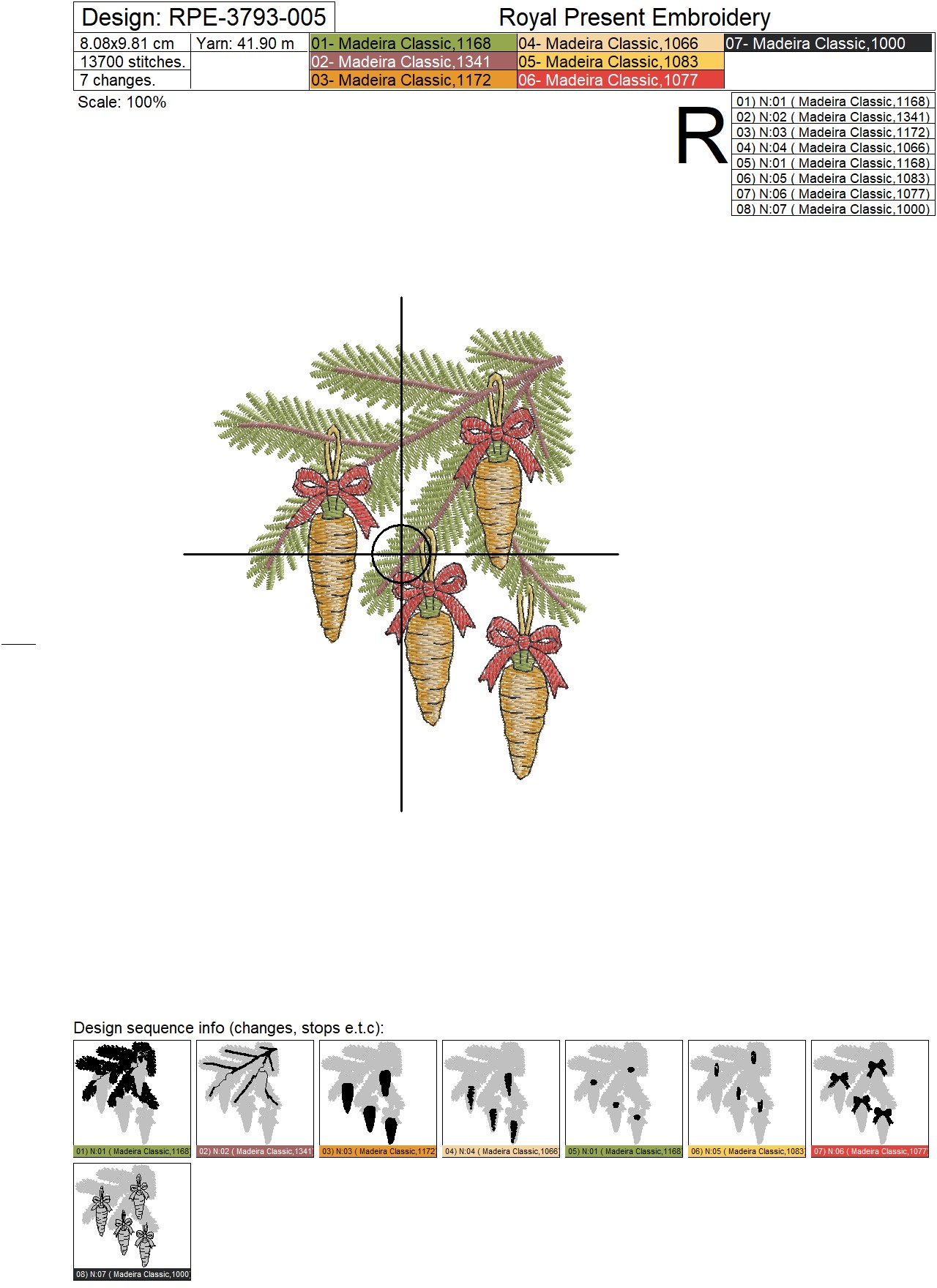
Size: 80.8x98.1 mm (3.18x3.86"), Stitches: 13662
Size: 88.8x107.9 mm (3.50x4.25"), Stitches: 15161
Size: 97.6x118.7 mm (3.84x4.67"), Stitches: 16858
Size: 107.4x130.7 mm (4.23x5.15"), Stitches: 18775Formats: .dst, .jef, .pec, .vip, .hus, .pes, .exp, .sew, .dat, .vp3, xxx
Before purchasing, compare both sides of the selected file with your machine's actual embroidery field. The outside dimensions of the plastic frame do not determine which file the machine can open. Read Embroidery Hoop Sizes and Stitching Fields for a detailed explanation.
Hoop Compatibility
| Version | Minimum practical field | What to check |
|---|---|---|
| First size | 100x100 mm | Very little total height clearance remains; run the machine's boundary trace before stitching |
| Second and third sizes | 100x170 mm or larger | The machine must support both file dimensions and one of the supplied formats |
| Fourth size | 130x180 mm or larger | A field only 100 mm wide is not sufficient |
All four versions fit within a true 130x180 mm embroidery field. On a machine limited to 100x100 mm, only the first file may fit, provided that the model supports the complete usable field and reads one of the supplied formats.
What Is Shown in the Design?
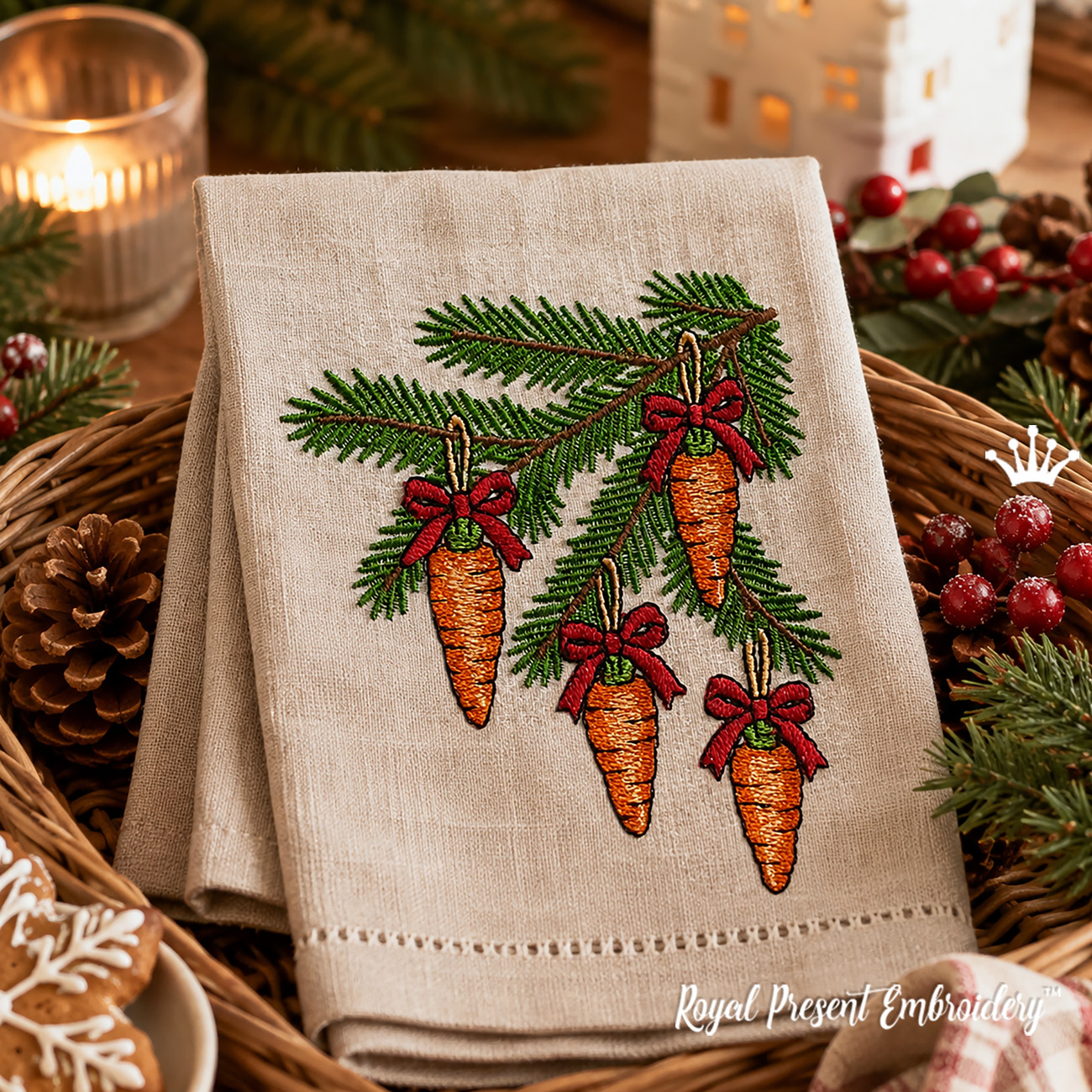
Four carrots hang from a fir branch on fine decorative loops, each finished with a red bow. The ornaments form a descending rhythm, giving the compact motif more movement than a conventional Christmas corner. Deep green needles, orange carrots and red ribbons create a recognizable holiday palette without standard baubles.
The composition is not limited to Year of the Rabbit projects. It works as a self-contained storybook Christmas motif for children's table settings, textile gifts and coordinated family holiday collections. Every element belongs to one design and stitches as a complete composition.
Where to Embroider the Fir Branch
- on the corner of a dinner napkin or fabric placemat;
- on a kitchen towel, guest towel or linen table runner;
- on a fabric gift bag or reusable wrapping;
- on a Christmas basket liner;
- on a decorative pillow or framed textile panel;
- on an apron, potholder or other kitchen textile;
- on a child's sweatshirt when supported with suitable cutaway backing.
For a napkin, fold the fabric exactly as it will be presented and place a full-size printed template on the visible panel. Keep every carrot inside the visible area, and make sure the lowest ornament does not cross a hem, drawn-thread edge or lace seam.
Stabilizer, Needle and Thread
| Fabric | Stabilization | Practical setup |
|---|---|---|
| Firm cotton or linen | Medium-weight tear-away backing underneath | Hoop the fabric and backing together without stretching the material |
| Loose linen or soft blend | Adhesive tear-away or lightweight cutaway backing | Support the complete branch area, not only the carrots |
| Knit fabric | Cutaway backing underneath | Use a suitable ballpoint embroidery needle and do not stretch the garment in the hoop |
| Terry cloth or velvet | Structural backing underneath and water-soluble topping above | The topping keeps the fir needles and bow details from sinking into the pile |
A new 75/11 embroidery needle and No. 40 thread are a practical starting point for smooth cotton or linen. Test an 80/12 needle on dense or layered material. An unnecessarily heavy needle can make the narrow hanging loops look coarse, so select the needle for the fabric rather than for the stitch count alone.
For stable woven fabric, a useful starting estimate is backing with a weight close to one third of the fabric weight. For example, test approximately 60 g/m² backing with 180 g/m² linen, then adjust the support after a complete sample stitch.
How to Keep Small Details Aligned
Registration errors are especially visible where the orange carrot fill meets the darker outlines, green tops, hanging loops and red bows. To keep these layers aligned:
- Hoop the fabric and backing as one stable layer without distorting the grain.
- Support the loose part of a napkin or runner so its weight cannot pull against the hoop carriage.
- Do not automatically combine repeated thread colors; a later stop may be required for the correct overlap sequence.
- If the edges of the bows begin to shift, reduce the machine speed and check upper and bobbin tension.
- Complete a full test stitch on matching fabric with the same backing before embroidering the finished item.
After Embroidery
Remove tear-away backing in small sections while supporting the stitches with your fingers so the narrow branches and hanging loops are not stretched. Trim cutaway backing around the design with a small, soft margin. Press from the wrong side on a folded towel and avoid flattening the raised bows. See Embroidery Care: Washing, Drying and Ironing Guide for laundering, drying and pressing instructions.
Matching Christmas Designs with Carrot Ornaments
Browse more coordinated holiday motifs in Christmas Character and Animal Machine Embroidery Designs and Christmas Machine Embroidery Designs.
Design author: Ludmila Konovalova, Royal Present Embroidery.
Frequently Asked Questions
Does the design fit a 100x100 mm hoop?
Only the first size may fit. Its height is close to the field limit, so the machine must support the complete usable 100x100 mm area. Run the boundary trace before stitching.
Do all four sizes fit a 130x180 mm hoop?
Yes. Every supplied file is smaller than a true 130x180 mm embroidery field on both sides. Also confirm that your machine reads one of the included formats.
Can the carrots and fir branch be embroidered separately?
No. The branch, hanging loops, bows and carrots form one complete design. Deleting individual elements may disrupt the programmed overlaps, underlay and tie stitches.
Is water-soluble topping needed on a linen napkin?
Usually not on firm, smooth linen. Topping is useful on terry cloth, velvet and other textured surfaces where narrow stitches can sink between the fibers.
Can this file be stitched as an FSL ornament?
No. It is digitized for stitching directly onto fabric and is not freestanding lace. Do not stitch it only on water-soluble stabilizer expecting a separate ornament.

 Get Sign-In Link
 Login with Google
 Login with Facebook
 Login with Amazon
 Login with Paypal