Metallic thread can turn a machine-embroidered snowflake into a true point of light. Silver resembles frost and ice, pale gold adds warmth to Christmas linens, and a flat holographic ribbon flashes as the fabric moves. The effect is spectacular, but metallic thread is less forgiving than standard 40-weight rayon or polyester. The wrong needle, excessive tension, poor thread delivery or an overly dense design can quickly cause shredding and breaks.
A reliable starting setup for a household embroidery machine: use a good-quality metallic thread close to 40 weight, install a new Metallic 80/12 or 90/14 needle, reduce the upper-thread tension in small steps, begin at a conservative speed of about 400–500 stitches per minute, provide a smooth thread path and test the complete design on the same fabric and stabilizer planned for the finished project. These are starting points, not universal machine settings; the thread manufacturer's instructions and the manual for your exact machine model take priority.
Explore Snowflakes and Stars Machine Embroidery Designs →
Why metallic embroidery thread breaks or shreds
Metallic is a visual effect, not one single thread construction. Some products use a synthetic core wrapped or covered with metallic film; others are narrow, flat decorative ribbons. Their flexibility, surface friction and recommended needle size are different. Treating every shiny thread as if it were ordinary 40-weight polyester is the first cause of trouble.
Most metallic-thread failures come from one or more of these conditions:
- Upper tension is too high. The thread is compressed in the tension system and repeatedly dragged through guides and the needle eye. The decorative surface can shift, fray or separate from the core.
- The needle eye is too small, worn or damaged. Metallic thread passes through the eye hundreds of times per minute. A rough edge or unsuitable eye can shred it rapidly.
- The thread is leaving the spool incorrectly. It may twist, catch on the spool edge, form a loop around the pin or spill from a cone faster than the machine can take it up.
- The machine is running too fast for the thread and design. More speed means more friction and heat. Short stitches and frequent direction changes make the problem worse.
- The embroidery is too dense for the chosen thread weight. Replacing 40-weight thread with a thicker 30-weight metallic increases the physical volume of thread inside the same stitch area.
- There is a burr somewhere in the thread path. A damaged guide, needle plate, hook or spool cap can repeatedly cut the thread at apparently random points.
- The thread itself is poor or old. If the metallic covering slips or flakes off with minimal handling, machine settings cannot make the spool reliable.
If the thread always fails in the same section of a design, also inspect that section for very short stitches, repeated penetrations or overlapping fills. Slowing the machine may reduce symptoms, but it will not correct unsuitable stitch geometry.
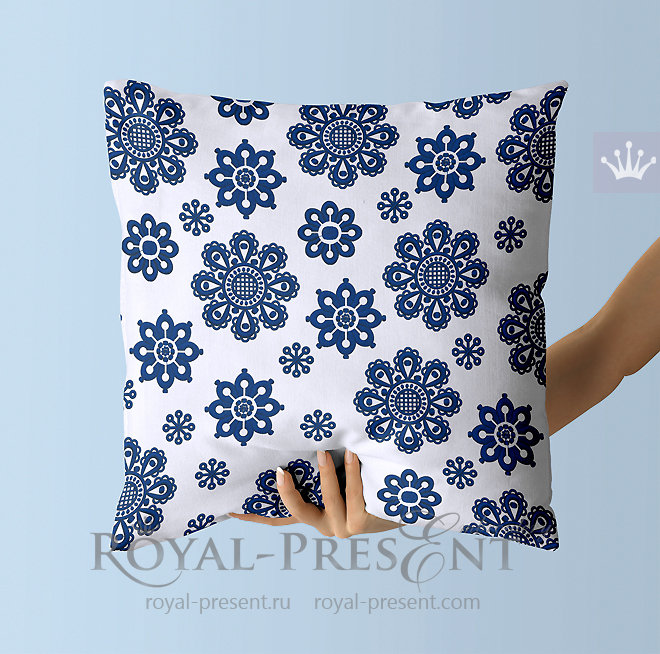
Christmas Snowflakes for socks machine embroidery designs - 2 sizes
Does metallic thread damage a household embroidery machine?
Quality metallic thread is not automatically dangerous to a properly maintained household machine. Household-machine manufacturers publish settings and accessories for metallic thread, and needle manufacturers make dedicated Metallic needles. The blanket claim that metallic thread inevitably damages a tension regulator is therefore inaccurate.
The real issue is that many household machines have a compact, enclosed thread path containing several turns, tension discs, sensors and an automatic cutter. A stiff or poorly constructed thread encounters friction at every point. It can shed decorative film or lint, and a hard metallic thread may accelerate cutter wear. In its guidance for selected 8 Series machines, BERNINA specifically recommends reducing upper tension and motor speed, using thread lubrication and switching off the automatic cutter to avoid excessive wear. That is model-specific guidance, not proof that all household machines are damaged by metallic thread.
Commercial multi-needle machines often make specialty-thread setup easier because cones feed from an external stand and each needle can have its own tension adjustment. One needle can remain prepared for metallic thread. However, a commercial machine cannot compensate for a damaged needle, defective thread, incorrect spool feed or a design that is too dense.
Metallic, Sliver and Holoshimmer are not the same thread
The terms metallic, glitter and shimmer are often used interchangeably in product descriptions, but the threads behave differently. Before changing machine settings, identify the actual product and weight printed on the spool.
| Thread | Construction or effect | Best use in snowflakes | Setup note |
|---|---|---|---|
| Gunold METY 7/2 | Thinner conventional metallic-effect embroidery thread; Gunold compares its density requirements with 40-weight thread | Fine and medium snowflakes, satin rays, outlines and standard designs digitized for 40-weight thread | The most logical METY starting point when replacing standard 40-weight embroidery thread |
| Gunold METY 5/2 | Heavier version; Gunold compares its density requirements with 30-weight thread | Bold contours, larger motifs and prominent decorative elements | Needs more needle clearance and a design suitable for heavier thread |
| Gunold GLITTER | Strong reflective special-effect thread | Statement rays, decorative stitching and selected highlights | Keep the feed controlled and follow the exact spool instructions |
| Gütermann Metallic | Metallic-effect machine embroidery thread for sparkling and iridescent accents | General decorative embroidery and individual metallic details | Use a needle and settings appropriate to the exact thread and fabric |
| Gütermann Sliver | Fine, flat metallic ribbon that creates shimmering accents | Icy lines, light decorative fills and a tinsel-like shimmer | A flat ribbon must feed without excessive twisting |
| Gütermann Holoshimmer | Fine holographic metallic ribbon with changing rainbow reflections | Fantasy snow, ice, children's winter projects and bright highlights | Usually most effective as an accent rather than a very dense fill |
| Madeira CR 40 | Standard-weight metallic with a polyester core covered by soft metallic and polyester foils | A wide range of snowflake designs normally stitched with 40-weight thread | Designed for high-speed industrial embroidery and available in 42 colors |
| Madeira CR 20 | Thicker metallic for depth, volume and bold definition | Large outlines, running-stitch effects and prominent shapes | Requires a design and needle intended for heavier thread |
Important name correction: the Gütermann product is Sliver, not Railway. Sliver is the name used by the manufacturer for its fine metallic ribbon. Holoshimmer is a separate holographic ribbon. The old phrase Sulky Railway should be removed from Royal Present articles and product descriptions because it is not the correct product name.
For a deeper review of this specific ribbon, see Gütermann Sulky Sliver Metallic Thread Review. That supporting article should remain focused on Sliver, while this page answers the broader question of how to embroider snowflakes with metallic and special-effect threads.
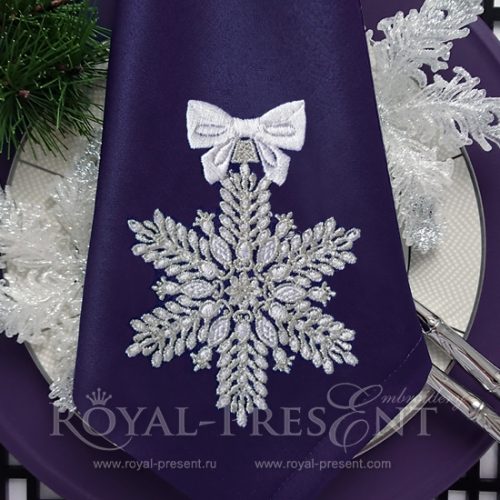
Gunold METY 7/2 versus METY 5/2
Gunold describes METY as a metallized polyamide/polyester thread and offers two strengths. METY 7/2 is the thinner option and is closer to a 40-weight thread in terms of stitch-density requirements. METY 5/2 is heavier and closer to 30 weight. This distinction matters more than the brand name alone.
If a snowflake design was digitized for ordinary 40-weight rayon or polyester, METY 7/2 is normally the safer of the two METY options to test first. Substituting METY 5/2 into the same dense fill without editing the design increases bulk, stiffness and needle penetrations per unit of thread volume. A larger needle does not solve excessive design density.
For classic winter embroidery, silver METY 7001 is a useful starting color, while gold METY 7005 works well for warmer Christmas palettes. Always check the current shade card and the exact 5/2 or 7/2 marking when ordering: color number and thread strength are separate specifications.
Gunold also stresses loose tension and controlled thread release. Its spool stockings are intended to prevent a smooth thread from slipping uncontrollably from the cone without pinching it. This is more precise than the common advice to put a net on every metallic spool: a net that is too tight can create additional drag and more breaks.
Madeira CR: why modern metallic thread can run differently
Madeira CR 40 illustrates why no single speed or needle rule applies to every metallic thread. Madeira describes CR 40 as a dtex 230 standard-weight metallic with a polyester core covered by soft metallic and polyester foils. The manufacturer lists 42 colors, needle sizes 65/9–75/11 and a running speed of 700–1000 stitches per minute on multi-head industrial embroidery machines.
Those figures do not mean that every household machine should immediately be set to 1000 stitches per minute. They show that thread construction affects performance. On a household machine, begin conservatively, follow the machine manual and raise speed only after a clean test. Madeira CR 20 is substantially heavier and uses larger needles, so it should not be dropped into a dense 40-weight snowflake without checking the digitizing.
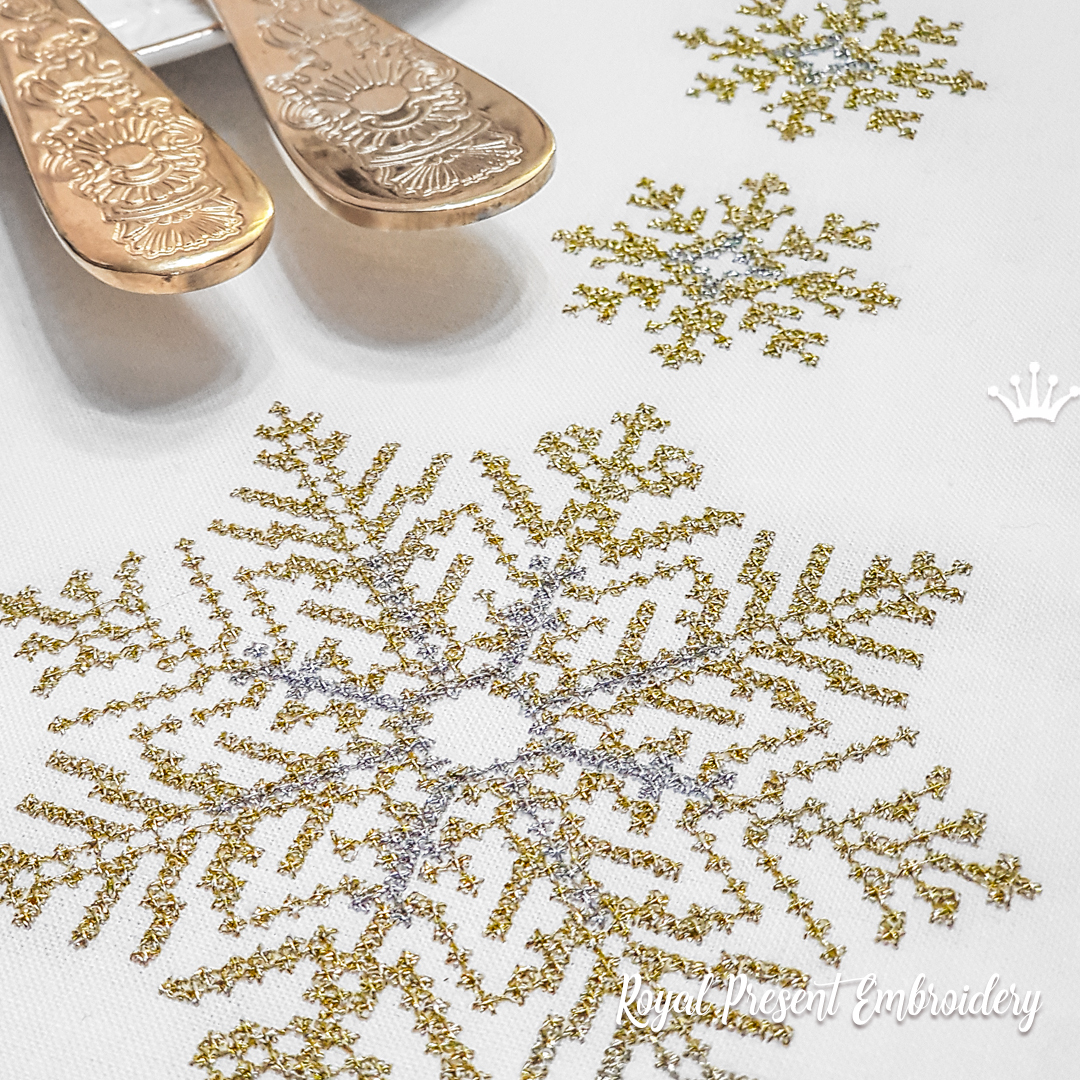
Christmas Snowflakes Cross-stitch Machine Embroidery Designs - 3 sizes
How to set up a household machine for metallic thread
-
Start with a new needle. SCHMETZ Metallic needles are available in 80/12 and 90/14 and have an elongated eye designed to reduce shredding and breaking. Choose the size according to thread weight and fabric. Some machine and thread manufacturers specify a different needle for particular products, so check both sets of instructions.
-
Inspect the thread before threading the machine. Pull off 8–12 inches (20–30 cm). If the decorative covering immediately bunches, flakes or exposes the core, test a different section or spool. Settings cannot repair structurally defective thread.
-
Use the correct spool orientation. Cross-wound cones and stacked spools do not always unwind in the same way. Follow the thread manufacturer's recommendation. A separate thread stand can add distance so the thread relaxes before entering the first machine guide. Flat ribbon must not accumulate twist.
-
Control overspin without choking the thread. Use the correct spool cap, foam pad, manufacturer-approved net or spool stocking only when required. The thread should leave the spool evenly, without spilling loops or being pulled under excessive resistance.
-
Thread the machine correctly. Raise the presser foot before rethreading so the tension discs can open. Confirm that the thread is seated in every guide and take-up point. Birdnesting underneath the fabric is commonly caused by an upper-threading problem.
-
Reduce upper tension gradually. There is no transferable universal number: a setting of 2 on one machine is not equivalent to 2 on another. Lower it in small steps until the thread stops shredding while the stitch remains balanced and no loose loops appear on the surface.
-
Begin at a lower speed. About 400–500 stitches per minute is a practical conservative test range for many household machines. If the design stitches cleanly, increase speed gradually. Keep it lower through short stitches, sharp direction changes and dense intersections.
-
Use normal embroidery bobbin thread. Metallic bobbin thread is unnecessary for ordinary embroidery on fabric and makes tension balancing more difficult. Reserve it for a project specifically designed to be metallic on both sides.
-
Check the cutter recommendation for your model. Some manufacturers advise turning off automatic cutting with metallic thread to limit cutter wear. If your manual gives this instruction, cut the metallic thread manually between color blocks.
-
Stitch the entire test, not only the first color. Use the final fabric, stabilizer, needle, bobbin thread and design size. Problems often appear only at overlaps or later dense sections.
To evaluate these settings on a real design, the Winter Snowflake Machine Embroidery Design in 3 sizes offers a decorative shape suitable for testing metallic or glitter effects. Use the original file size and test before stitching the final item.

How to use silicone thread lubricant safely
Silicone lubricant reduces friction; it does not strengthen thread or correct faulty digitizing. Gunold Silicone Spray 610 is marketed for rayon and metallic threads to help them run more smoothly and is described as non-staining. BERNINA also notes that silicone lubrication can improve thread travel through the needle and reduce breakage on rough, break-prone threads.
Use lubricant as a controlled troubleshooting step:
- choose a clear product specifically intended for sewing or embroidery thread;
- follow the product label and your machine manufacturer's instructions;
- apply only the minimum required amount to the thread or an approved thread-lubricating device;
- never spray a general-purpose aerosol into the machine, onto sensors, belts, electronics or over the hooped project;
- test first on scrap fabric, especially with silk, velvet, light satin or another surface that marks easily;
- check the stitch balance again after lubrication, because a more freely moving thread may require a small tension adjustment.
Automotive silicone, penetrating oil and WD-40 are not substitutes for a textile-thread lubricant. If a new Metallic needle and correct thread feed solve the problem, additional lubricant may not be necessary.
Digitizing rules: thread weight, density and stitch length
A well-made snowflake design can be more important than the machine brand. Metallic thread performs best where it has enough room to lie cleanly and reflect light. Medium-width satin rays, open linework and selected decorative accents usually show more sparkle than an extremely dense fill.
Good candidates for metallic thread include:
- openwork and geometric snowflakes;
- medium-width satin columns with smooth direction changes;
- longer decorative running stitches without excessive repeat passes;
- designs that combine metallic highlights with rayon or polyester body colors;
- larger motifs digitized specifically for 30-weight or other heavy specialty thread.
Potential problem areas include very short stitches, repeated tie-ins, triple runs over the same path, thick overlapping fills and multiple dense layers at the center of a snowflake. Do not substantially shrink a finished embroidery file in the machine and assume it will remain suitable for metallic thread. The design may become physically smaller while minimum stitch lengths and density become unacceptable.
The Sparkling Christmas Snowflake Machine Embroidery Design in 3 sizes is linked on the site with the old incorrect Railway wording. When that product page is updated, the thread reference should be changed to Gütermann Sliver and the setup should be tested for each of the three original sizes.
Stabilizer for snowflake machine embroidery
Metallic thread cannot compensate for moving fabric. Stabilization must control the base material without making the finished item unnecessarily stiff. Use the stabilizer type required by the fabric and the design density.
| Fabric or project | Starting stabilizer choice | Practical note |
|---|---|---|
| Linen, cotton napkins and stable woven fabric | Suitable tear-away stabilizer | Hoop without stretching the fabric; increase support for a dense or large snowflake |
| Velvet and terry cloth | Stable backing below plus water-soluble topping above | The topping keeps fine stitches from sinking into the pile |
| Fleece, knits and stretch garments | Cut-away stabilizer; topping if the surface is textured | Support must remain after embroidery so the design does not distort in wear |
| Organza and sheer fabrics | Water-soluble stabilizer or a fine backing appropriate to the project | Choose an open design and fine metallic thread; dense crossings can perforate delicate fabric |
| Freestanding lace snowflake | Heavy water-soluble stabilizer specified for FSL | Only use a design explicitly digitized as freestanding lace; a lace-looking fabric design may fall apart when the stabilizer dissolves |
For broader winter-project ideas and fabric recommendations, see Winter Decorations Machine Embroidery Designs.
Metallic-thread troubleshooting chart
| Symptom | Likely cause | What to change first |
|---|---|---|
| Thread frays directly above the needle | Needle eye is too small, worn, damaged or unsuitable | Install a new Metallic needle in the correct size |
| Breaks occur in different places | High tension, excessive speed, spool jerks or incorrect threading | Rethread, check feed, reduce tension in small steps and slow the machine |
| Metallic covering slides away from the core | Poor thread construction or a rough guide | Inspect the thread path and test a quality spool |
| Loose loops appear on top | Upper tension is too low or the thread is not seated in the discs | Rethread with the presser foot raised and increase tension slightly |
| A thread nest forms underneath | Upper-threading error is more likely than a bobbin problem | Stop, remove the nest and completely rethread the upper path |
| Flat ribbon twists and loses its broad shine | Incorrect spool orientation or accumulated twist | Change spool position and guide the ribbon so it feeds smoothly |
| Breaks always occur at the snowflake center | Too many overlapping paths or very short stitches | Inspect the stitch file; use a thinner thread or revise the digitizing |
| Fabric puckers around the design | Insufficient stabilization, poor hooping or excessive density | Improve stabilization and return to the original design size |
Choosing snowflake designs for Christmas and winter projects
Metallic thread is most effective when light can travel along clean satin stitches or catch selected lines. It does not need to cover the entire design. Combining silver metallic with white rayon can produce more depth than stitching every color block in the same shiny thread.
Use smaller snowflakes for napkin corners, guest towels, stockings, gift bags and scattered accents. Larger designs can become the main feature on table runners, pillows, wall panels or winter garments. On dark blue, black, burgundy or emerald velvet, cool silver creates strong contrast. Pale gold and champagne tones are softer on cream linen, ivory satin and natural cotton.
Browse the complete Snowflakes and Stars Machine Embroidery Designs collection to compare hoop sizes, stitch counts and styles. Product photos show design appearance, but always use the exact size and stitch information printed on the individual product page before purchasing.
For more information about rayon, polyester, cotton and other specialty threads, continue with Choosing the Right Threads for Your Machine Embroidery Projects.
Frequently asked questions
What needle should I use for metallic machine embroidery thread?
For many household machines, a new Metallic 80/12 or 90/14 needle is a strong starting choice. Its elongated eye helps reduce shredding. Match the needle to the exact thread weight and fabric, and follow any different specification supplied by the thread or machine manufacturer.
Can I use metallic thread on Brother, Janome, BERNINA, Pfaff, Husqvarna Viking or Baby Lock machines?
Yes, provided the machine manual permits the thread and the setup is appropriate. Use the recommended needle, provide smooth spool feed, lower speed and adjust upper tension only after a test. Follow model-specific instructions concerning the automatic cutter or additional thread guide.
What speed should I use for metallic thread?
There is no universal metallic-thread speed. About 400–500 stitches per minute is a conservative test range for many household machines, but construction matters: Madeira rates CR 40 for much higher speeds on industrial multi-head equipment. Increase speed only after a clean test on the final fabric and stabilizer.
Should I lower the upper-thread tension?
Often, yes. Make small adjustments rather than jumping to the lowest setting. Excessive tension can shred the thread; tension that is too low produces loose loops and poor stitch balance. Numeric settings are not directly comparable between machine brands.
Can metallic thread be used in the bobbin?
It is usually unnecessary for standard fabric embroidery. Fine polyester embroidery bobbin thread creates a cleaner, easier-to-balance result. Use metallic in the bobbin only for a project that must look metallic on both sides and after making a separate tension test.
Is Gütermann Sliver the same as Holoshimmer?
No. Gütermann describes Sliver as a fine metallic ribbon for shimmering accents and Holoshimmer as a fine holographic metallic ribbon. They are separate products. Railway is not the correct name for either thread.
Will silicone spray stop metallic thread from breaking?
It can help when friction is the cause. It will not fix a damaged needle, incorrect threading, poor-quality thread or excessive stitch density. Use only a product intended for embroidery thread and apply it according to the product and machine instructions.
Can I replace 40-weight polyester with 30-weight metallic without editing the design?
Not safely in every design. A heavier thread occupies more space. Open outlines may stitch well, while dense fills and overlapping centers can become stiff or break repeatedly. Test first and use a design digitized or adjusted for the heavier thread when necessary.
The practical formula for a clean metallic snowflake
Begin with a quality metallic close to the weight for which the design was digitized. Install a new appropriate needle, organize smooth thread delivery, reduce upper tension and speed only as much as the test requires, use standard bobbin thread, stabilize the fabric correctly and keep the design at its intended size. If the machine manual advises disabling the automatic cutter for metallic thread, cut manually.
The best result rarely comes from making every stitch metallic. Use shine deliberately: along satin rays, ornamental lines and selected areas that can catch the light. The contrast between metallic, white rayon and matte fabric is what makes an embroidered snowflake look dimensional rather than merely reflective.
Choose a Snowflake Machine Embroidery Design for Your Next Project →

Author: Ludmila Konovalova
My name is Ludmila Konovalova, and I lead Royal Present Embroidery. Embroidery for me is more than a profession; it is a legacy of my Ukrainian and Bulgarian heritage, where every woman in my family was a virtuoso in cross-stitch and smooth stitching. This art, passed down through generations, is part of my soul and a symbol of national pride.
Date: 23.07.2026

 Get Sign-In Link
 Login with Google
 Login with Facebook
 Login with Amazon
 Login with Paypal