Monochrome Leafy Branch Corner Machine Embroidery Design - 5 Sizes
By knowing the speed of your embroidery machine, you can find out how long it will take to embroider a design.
To use the embroidery calculator, click on the number of stitches in the product description.
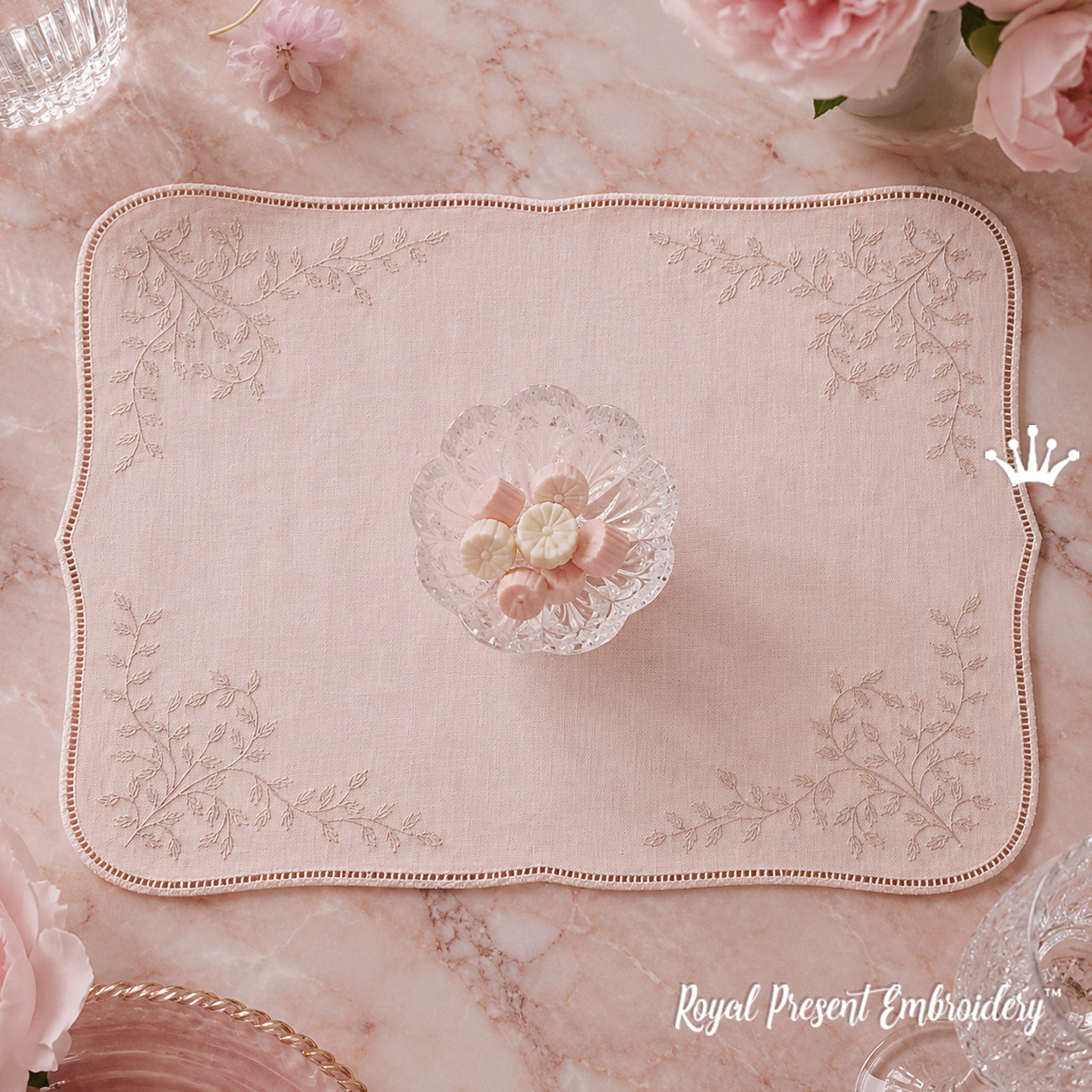
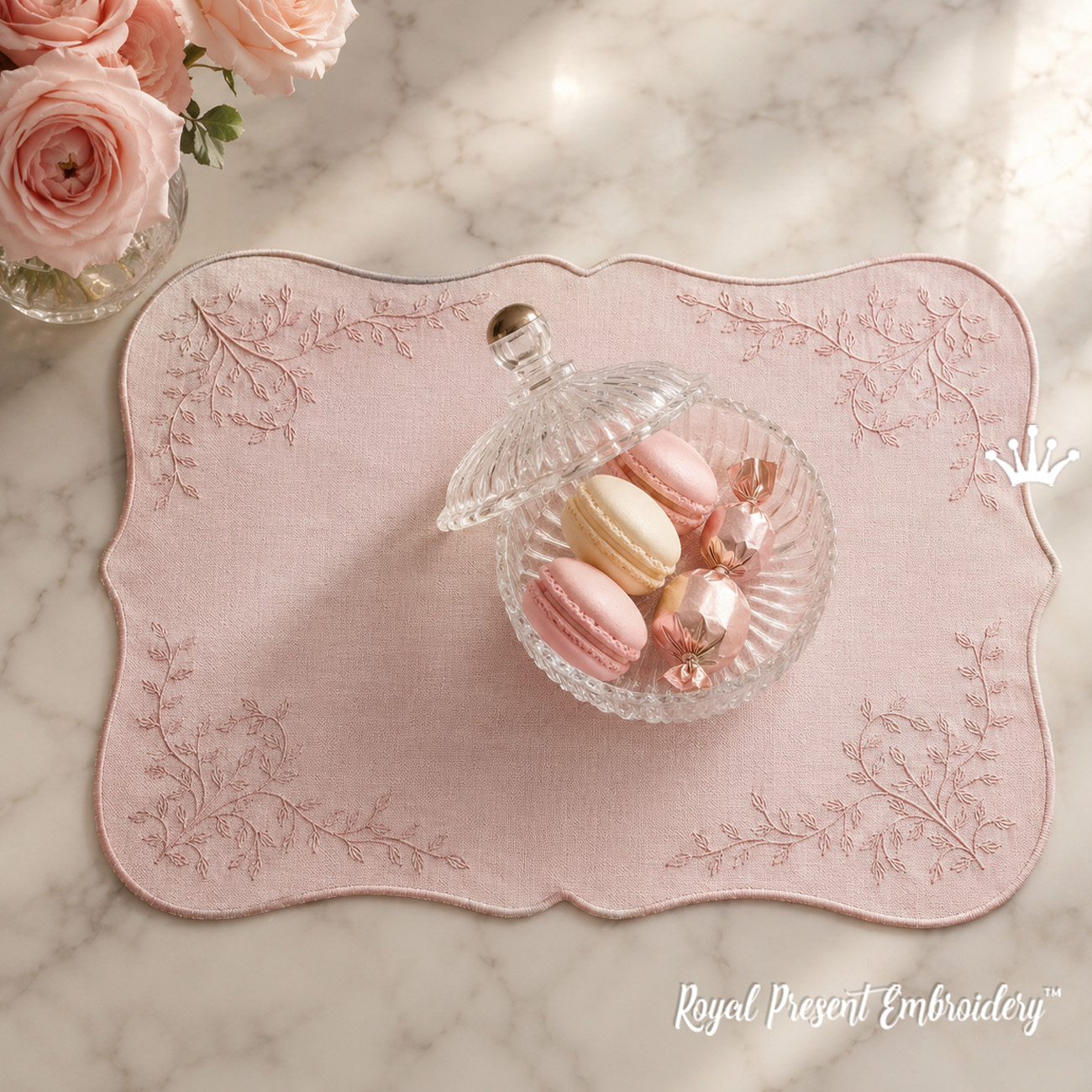
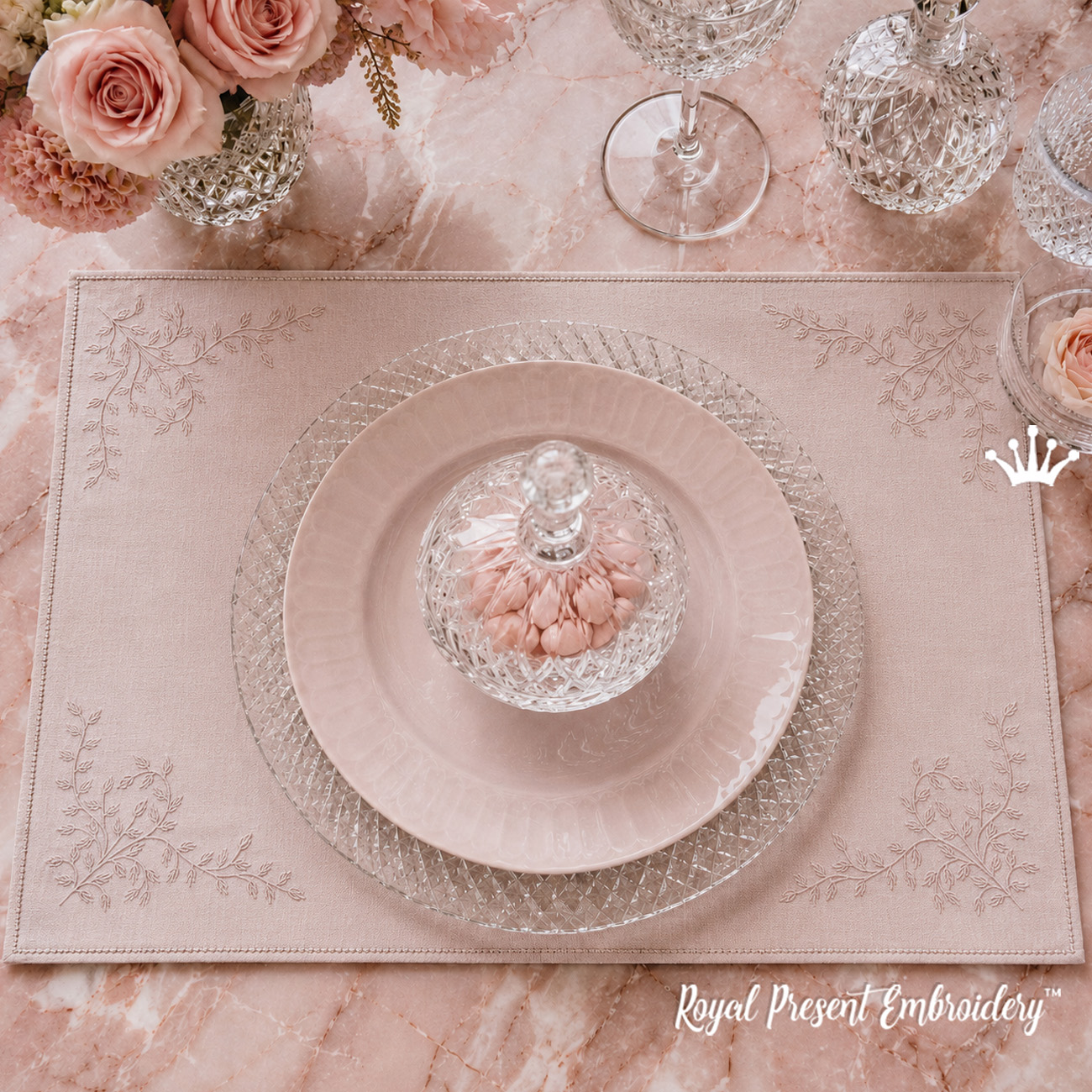
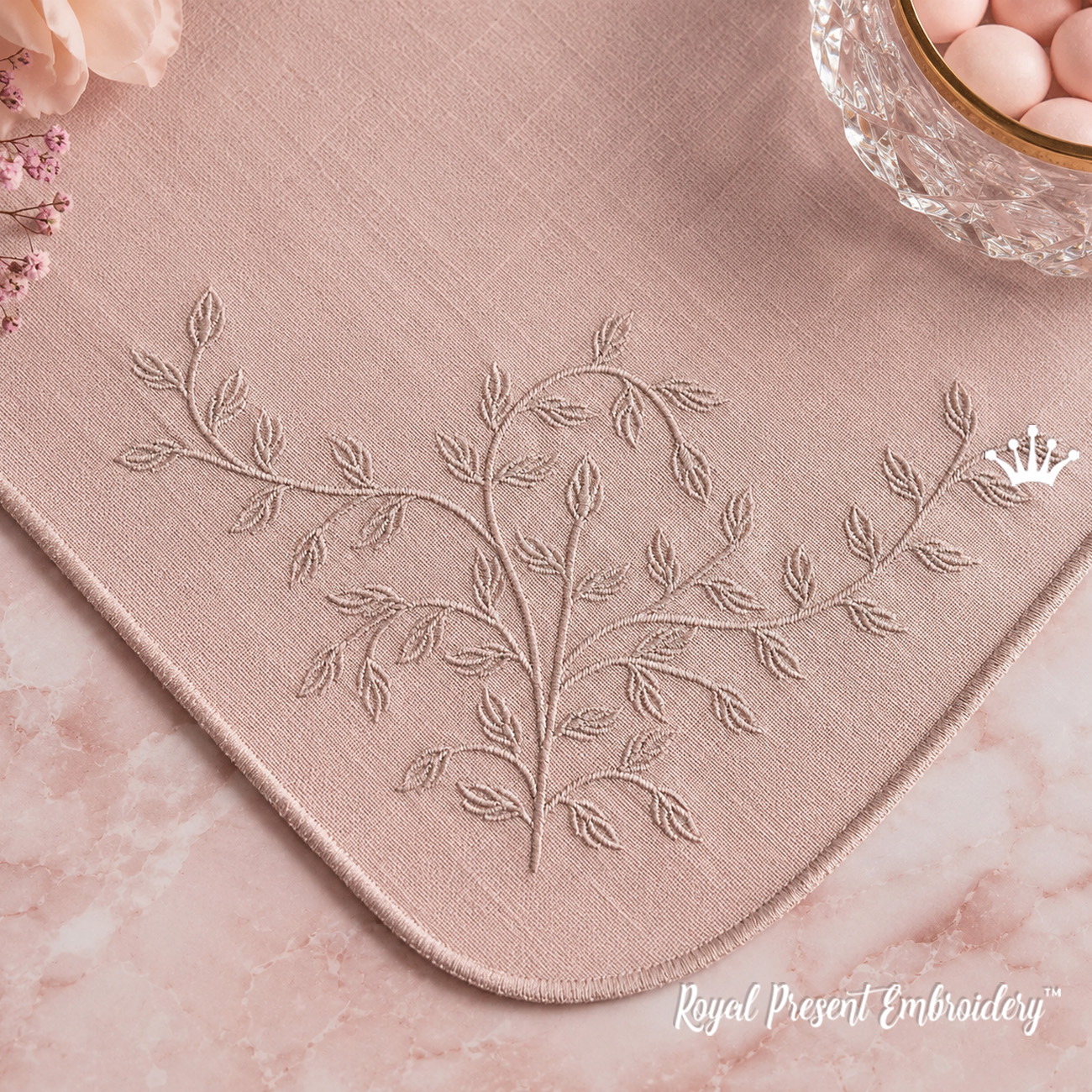
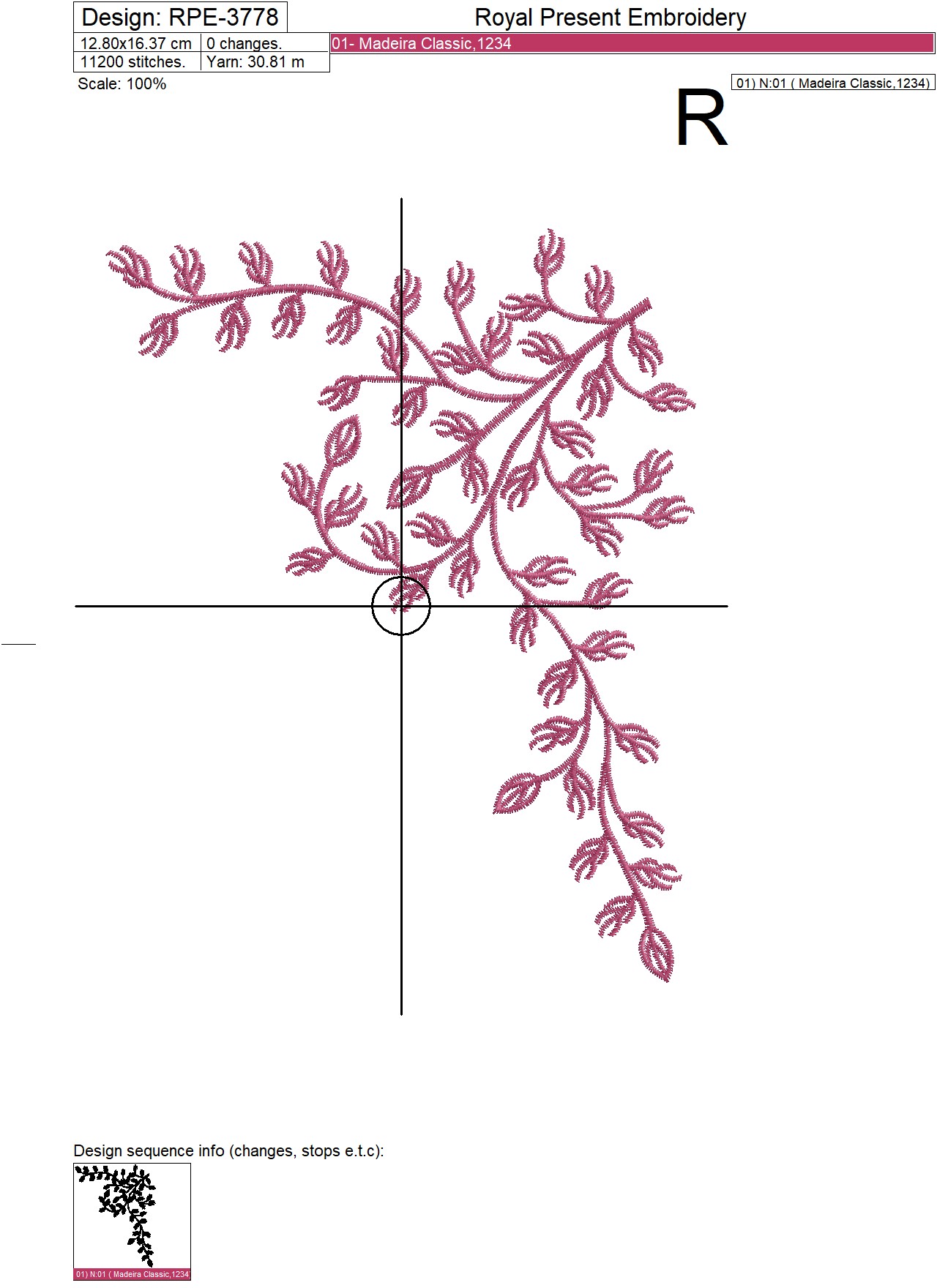
Monochrome Leafy Branch Corner Machine Embroidery Design is a light botanical composition formed by thin curved branches and small leaves extending in two directions from a corner. Five sizes provide options for linen napkins, placemats, table runners, tablecloth corners, pillowcases, guest towels, quilts and coordinated home décor projects.
The entire composition stitches in one color without thread changes. Select a thread close to the fabric color for a subtle tone-on-tone effect, or use a contrasting shade to make the delicate branches and individual leaves more visible.
This product contains machine embroidery files for an embroidery machine. It is not a finished napkin, placemat, table runner, tablecloth, pillowcase or other physical product.
Product Details
- Size: 128.0x163.7 mm (5.04x6.44 "), Stitches: 11131
- Size: 176.8x138.3 mm (6.96x5.44 "), Stitches: 11987
- Size: 198.3x155.1 mm (7.81x6.11 "), Stitches: 13354
- Size: 227.9x178.3 mm (8.97x7.02 "), Stitches: 15232
- Size: 253.5x198.3 mm (9.98x7.81 "), Stitches: 16893
Formats: .dst, .pec, .exp, .hus, .vip, .pes, .dat, .vp3, .sew, .tab. xxx
Color sequence: one color without thread changes.
What Does the Botanical Corner Look Like?
The composition begins at one corner point and extends along two neighboring sides. Fine stems curve naturally away from the center, while small leaves are placed at intervals along the branches.
There is no dense flower, central bouquet or heavy ornamental fill. Most of the background fabric remains open, allowing the design to frame a corner without covering the main surface of the project.
The long, airy shape is especially useful when the embroidery should follow the edges of a rectangular or square item while leaving room for dishes, table accessories, additional embroidery or a central decorative element.
Why Choose a One-Color Corner Design?
- the complete composition stitches without color changes;
- thread color can be coordinated with any fabric palette;
- tone-on-tone stitching creates a subtle raised texture;
- contrasting thread makes the fine botanical lines more visible;
- one thread color simplifies coordinated sets of several items;
- the open structure keeps the finished project light and uncluttered.
Recommended Projects
- linen and cotton dinner napkins;
- placemats and individual table settings;
- tablecloth corners and square table toppers;
- table runners and dresser scarves;
- decorative pillowcases and cushion fronts;
- smooth guest towels;
- quilt, bedspread and light throw corners;
- fabric panels and framed botanical pieces;
- coordinated table-linen gift sets.
Which Hoop Fits Each Size?
The 128.0x163.7 mm version may fit a nominal 130x180 mm or 5x7 inch embroidery field when the machine supports the complete 128.0 mm width and 163.7 mm height.
The 176.8x138.3 mm version may fit a nominal 140x200 mm or 5.5x8 inch field after rotation, provided the machine supports at least 138.3x176.8 mm in the required orientation.
The 198.3x155.1 mm version may fit a nominal 160x240 mm or 6.3x9.45 inch field when rotated to 155.1x198.3 mm.
The 227.9x178.3 mm version may fit a nominal 180x300 mm or 7.09x11.81 inch field when positioned as 178.3x227.9 mm.
The 253.5x198.3 mm version may fit a nominal 200x300 mm or 8x12 inch field when positioned as 198.3x253.5 mm.
Always compare both exact design dimensions with the real usable field of your embroidery machine. A commercial hoop name does not guarantee that every machine can stitch the complete nominal area.
How Do You Choose the Right Size?
Begin by measuring the finished corner area rather than choosing only by hoop capacity. The complete branches must remain inside the visible project surface and clear of hems, binding, decorative stitching and construction seams.
The first size is usually the most practical choice for a smaller dinner napkin or compact placemat. The first, second and third sizes provide longer framing lines for medium and large placemats.
The fourth and fifth sizes are better suited to large tablecloth corners, table runners, pillow panels, quilt corners, bed linens and other projects with a wide open area.
Print the chosen size at full scale and place the template on the fabric before hooping. This confirms both technical fit and visual proportion.
How Do You Position the Design in a Corner?
- Mark the two finished edges of the project.
- Mark the exact point where the two finished edges meet.
- Include the width of the hem, binding or decorative border in the placement plan.
- Place the full-size design template over the marked corner.
- Adjust the template until both branches have visually equal spacing from the neighboring edges.
- Mark the design center and horizontal and vertical reference lines.
- Hoop or float the project without distorting the fabric grain.
- Check the orientation on the machine screen before starting.
The leaves and branch tips should not enter a hem, mitered corner, piping, drawn-thread area or thick binding. On a finished napkin, measure from the already completed edges rather than from the raw fabric.
How Do You Repeat the Design in Two or Four Corners?
The corner can be repeated in two opposite corners or in all four corners of a tablecloth, placemat, pillow or quilt block. Rotate the composition by 90, 180 or 270 degrees for each new position when supported by the machine or embroidery software.
Before embroidering, arrange full-size paper templates in every planned corner. Compare the spacing between the branches, finished edges and central usable area.
Create one reusable placement template or measuring guide for a coordinated set of napkins. Use the same reference points for every item so the embroidered corners appear consistent when the set is placed together.
Which Fabric Works Best?
The fine branches and small leaves are clearest on a smooth, stable surface. Suitable materials include linen, cotton, cotton-linen blends, table-linen fabric, gabardine, twill and stable fabric intended for placemats or decorative cushions.
Loose linen needs reliable stabilization because thin branch stitches may shift between the woven threads. Very lightweight fabric should be tested to confirm that the embroidery does not create visible ripples or an excessively heavy reverse side.
Deep terry cloth and strongly textured waffle fabric are less suitable because the small leaves may disappear into the surface. For a towel project, a smooth woven decorative band or separate flat insert produces a clearer result.
Which Stabilizer Should You Use?
For stable medium-weight cotton or firmly woven linen, medium-weight tear-away stabilizer may be tested. It should cover the complete hoop opening and remain secure throughout the embroidery.
For loose linen, frequently washed napkins, table runners, pillowcases and handled projects, lightweight cutaway stabilizer is the safer option. Permanent backing continues to support the long branches and small leaves after washing.
For delicate table linen where a clean reverse side is especially important, test a suitable water-soluble stabilizer or a combination of thin permanent support and water-soluble material.
Do not stretch the fabric in the hoop. The surface should remain smooth and secure while retaining its natural dimensions and grain direction.
How Do You Create Tone-on-Tone Embroidery?
Select a thread close to the base-fabric color. On beige, blush, gray or ivory linen, a matching or slightly lighter thread creates delicate relief that becomes visible as the light moves across the stitched branches.
On white fabric, consider pearl, champagne, pale gray, powder pink, soft gold-beige or pastel blue. On natural linen, cream, ivory, sage, taupe and muted brown create a restrained botanical appearance.
For a stronger contrast, use dark green, burgundy, navy, graphite or black. High contrast makes every branch more visible, but it also reveals tension problems and small registration irregularities more clearly. Complete a test stitch first.
Can You Use Variegated Thread?
Variegated thread can emphasize the direction of the curved branches and introduce gentle color changes without adding separate machine color stops.
Choose a thread with smooth, gradual transitions. Abruptly contrasting sections may divide one thin branch into disconnected-looking areas, especially in the smallest size.
Longer color repeats usually distribute more naturally through the larger design sizes. Test the thread on the intended fabric to evaluate the final color spacing.
Can You Use Metallic Thread?
Metallic thread can create an elegant single-color corner for formal table linens, holiday settings, decorative pillows and special gifts. Pale gold, champagne, silver and antique gold are practical options.
- use a needle suitable for metallic embroidery thread;
- reduce the machine speed;
- allow the spool to unwind freely without twisting;
- check the thread path for excessive friction;
- test the complete design before embroidering the final project.
Because the design contains long curved lines and small leaves, unstable metallic thread can produce loops or breaks. Do not begin the final item without testing the selected spool, needle and tension.
How Do You Prevent Puckering?
- do not stretch linen or cotton while hooping;
- align the fabric with the lengthwise and crosswise grain;
- use stabilizer larger than the complete hoop opening;
- match the stabilizer to the fabric weight and weave;
- avoid tightening the upper thread more than necessary;
- support a large tablecloth or runner near the machine;
- do not allow the project weight to pull on the carriage;
- test the design on the same fabric and stabilizer combination.
Needle, Thread and Machine Speed
Use a fresh 75/11 embroidery needle for medium-weight linen and cotton. An 80/12 needle may be appropriate for a dense placemat, heavy table fabric or multilayer decorative panel.
Quality polyester embroidery thread is practical for napkins, tablecloths and runners that will be washed regularly. Before the final project, check that the bobbin thread does not pull onto the front of the thin branches.
Reduce the machine speed if the fabric begins to move or the curves lose smoothness. Pay particular attention to the long outer branches and the smallest leaves near the ends of the composition.
Comparison with Other Corner Designs
Choose this monochrome leafy branch corner when you need an open, delicate botanical frame with no color changes and five larger sizing options.
- For a different one-color leaf composition with denser foliage, see the Leaves Corner Machine Embroidery Design - 3 Sizes.
- For a multicolor decorative interpretation, see the Corner Baroque with Colorful Leaves Machine Embroidery Design.
- For a non-botanical one-color ornamental alternative, see the Ornate Arabesque Corner Machine Embroidery Design.
Explore Related Corner Collections
- Browse natural, floral and leafy motifs in Floral Corners Machine Embroidery Designs.
- Browse botanical, ornamental, folklore, lace and seasonal options in Corners Machine Embroidery Designs.
Do Not Resize the Design Yourself
Do not reduce or enlarge the supplied files independently. Changing the size without professional stitch recalculation can damage stitch length, density, underlay, pull compensation, leaf shapes and the smooth flow of the thin branches.
Royal Present is not responsible for embroidery quality after the customer independently resizes, edits or converts the supplied files.
About the Designer
This Royal Present Embroidery design was created by Ludmila Konovalova, machine embroidery designer.
FAQ
Does the complete design stitch in one color?
Yes. The complete leafy branch composition stitches in one color without thread changes. Change the appearance by selecting a tone-on-tone, contrasting, variegated or metallic thread.
Which size may fit a 130x180 mm or 5x7 inch hoop?
The smallest file measures 128.0x163.7 mm and may fit a nominal 130x180 mm field. Confirm that your machine supports the full 128.0 mm width and 163.7 mm height.
Can the second size fit a 140x200 mm hoop?
The 176.8x138.3 mm file may fit after rotation when the machine supports a usable field of at least 138.3x176.8 mm in the required orientation.
Which hoop is required for the largest size?
The largest file measures 253.5x198.3 mm. A nominal 200x300 mm field may be suitable when the design is positioned as 198.3x253.5 mm and the machine supports both complete dimensions.
How should the design be placed on a napkin or placemat?
Mark the two finished edges and the future corner point. Position a full-size template so both branches have visually equal spacing from the neighboring edges, hems and binding.
Can the design be repeated in all four corners?
Yes. Arrange four full-size templates before embroidering and check the symmetry. Rotate the composition for each corner while keeping equal spacing from the finished edges.
Which stabilizer works for a linen napkin?
Medium tear-away may work for stable, tightly woven linen. Lightweight cutaway is safer for loose linen, frequently washed napkins and projects where the long branches require permanent support.
Can the corner be stitched with thread matching the fabric?
Yes. Tone-on-tone thread creates a subtle raised botanical effect. Choose a shade slightly lighter or darker than the fabric when more visibility is required.
Is the design suitable for terry towels?
Smooth fabric is preferable because small leaves and thin branches may disappear in deep pile. For terry cloth, use cutaway stabilizer underneath, water-soluble topping above and complete a test stitch.
Can variegated or metallic thread be used?
Yes. Choose gradual variegated color transitions or suitable embroidery metallic thread. Reduce the machine speed and test the complete design before stitching the final item.
Can I resize the files myself?
No. Independent resizing can damage stitch length, density, underlay, pull compensation, leaf shapes and branch curves. When another size is required, use the professional Resize of Design service.
Is a test stitch necessary?
Yes. A test confirms exact hoop compatibility, stabilizer performance, thread tension, leaf clarity, branch smoothness and the absence of puckering on the selected fabric.

 Get Sign-In Link
 Login with Google
 Login with Facebook
 Login with Amazon
 Login with Paypal