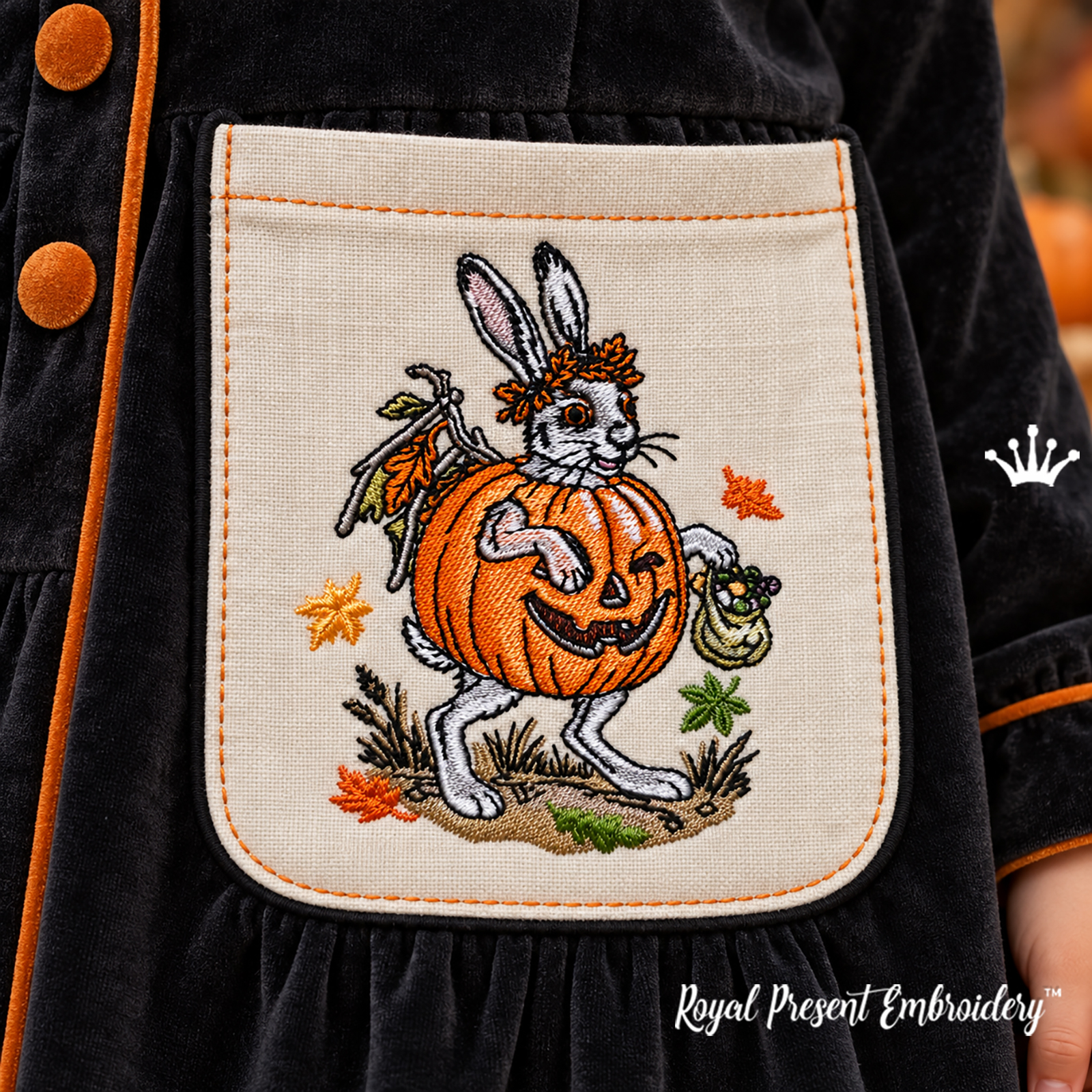
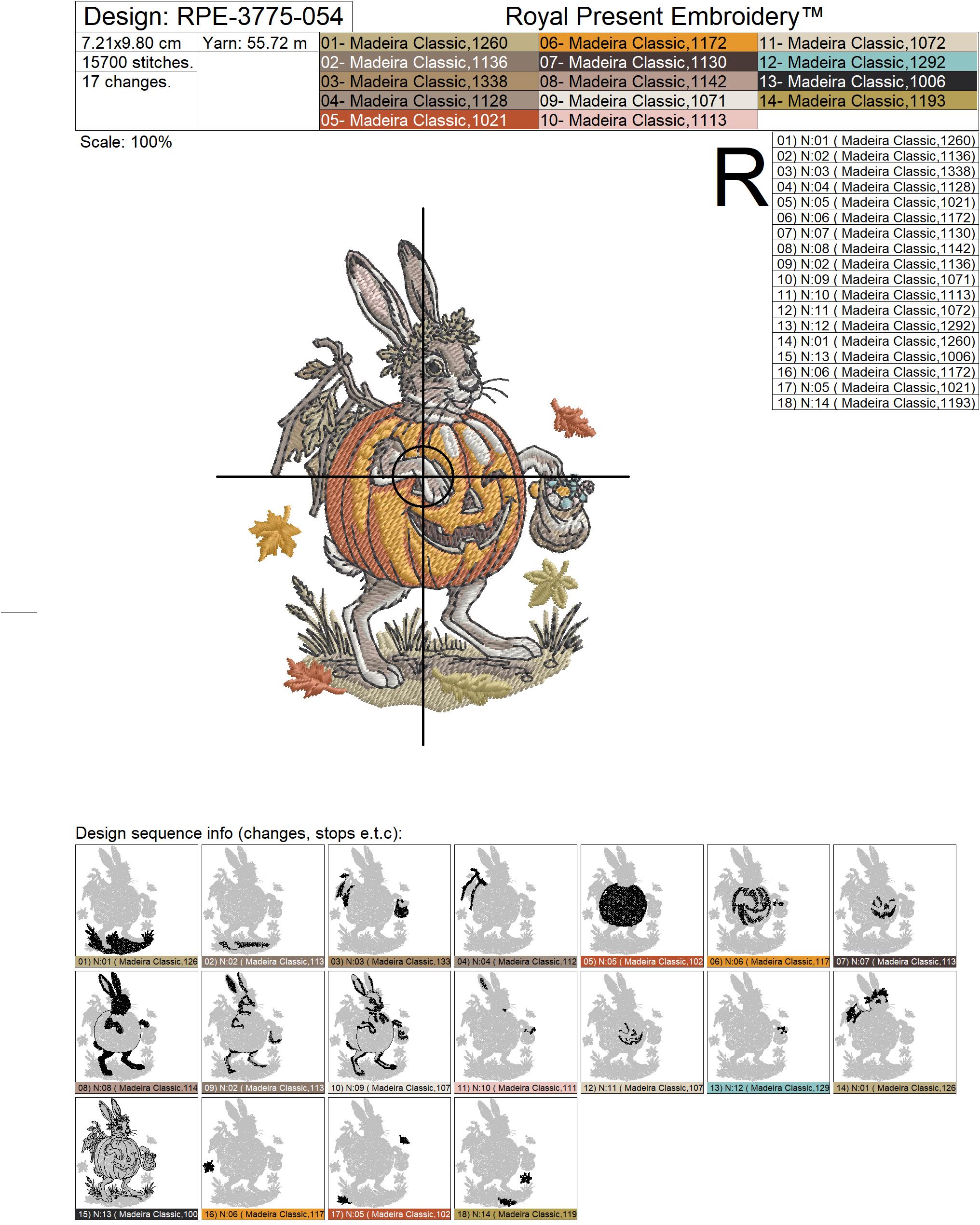
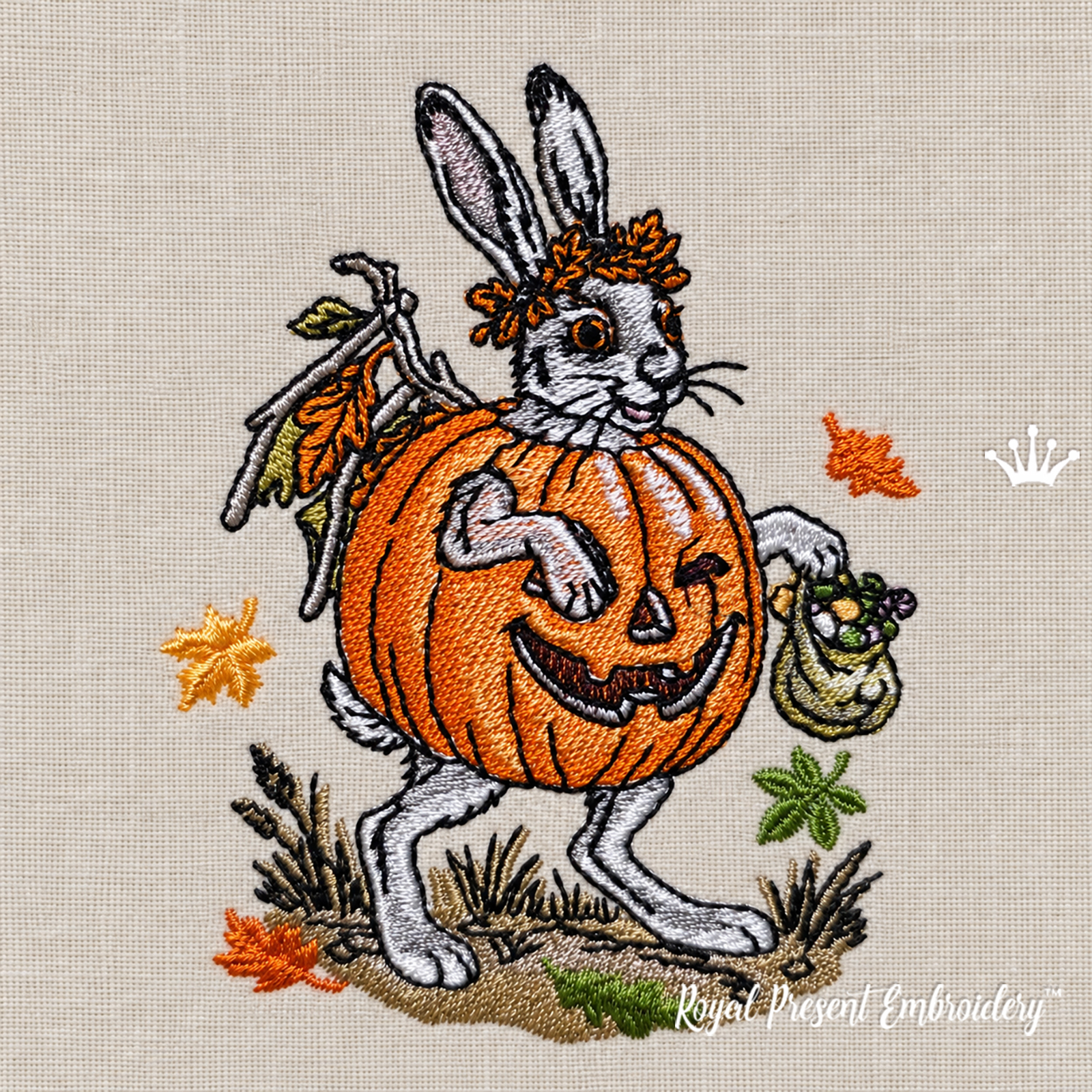
This autumn chapter in the bunny story shows a gray-and-white bunny reaching over a carved jack-o'-lantern. Maple leaves, a twig, grass, and a small pouch complete the vertical scene for an apron, a sturdy cotton tote panel, a sweatshirt, or a decorative cushion.
This is a digital machine embroidery design, not a finished product. Each size is supplied as a separate file for a compatible embroidery machine.
Sizes and compatible hoops
| Size and stitches | Compatible hoop |
|---|---|
| Size: 72.1x98.0 mm (2.84x3.86 "), Stitches: 15700 | 100x100 mm (4x4") |
| Size: 79.3x107.8 mm (3.12x4.24 "), Stitches: 17700 | 100x170 mm (4x7") |
| Size: 87.1x118.6 mm (3.43x4.67 "), Stitches: 19700 | 100x170 mm (4x7") |
| Size: 95.7x130.4 mm (3.77x5.13 "), Stitches: 22300 | 100x170 mm (4x7") |
| Size: 105.3x143.4 mm (4.15x5.65 "), Stitches: 25300 | 130x180 mm (5x7") |
Formats: .dst, .jef, .pec, .vip, .hus, .pes, .exp, .sew, .dat, .vp3, .xxx
More from the bunny story
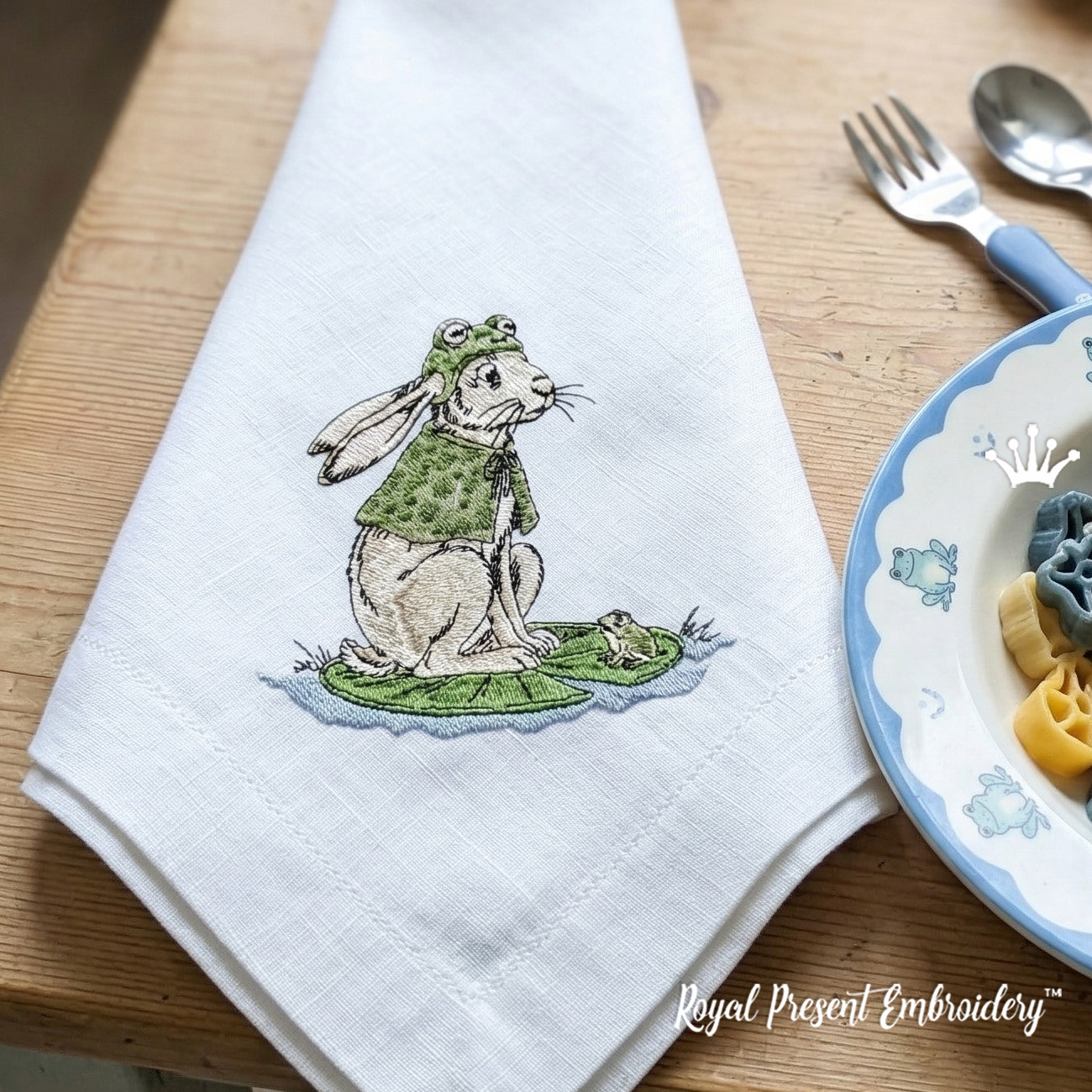
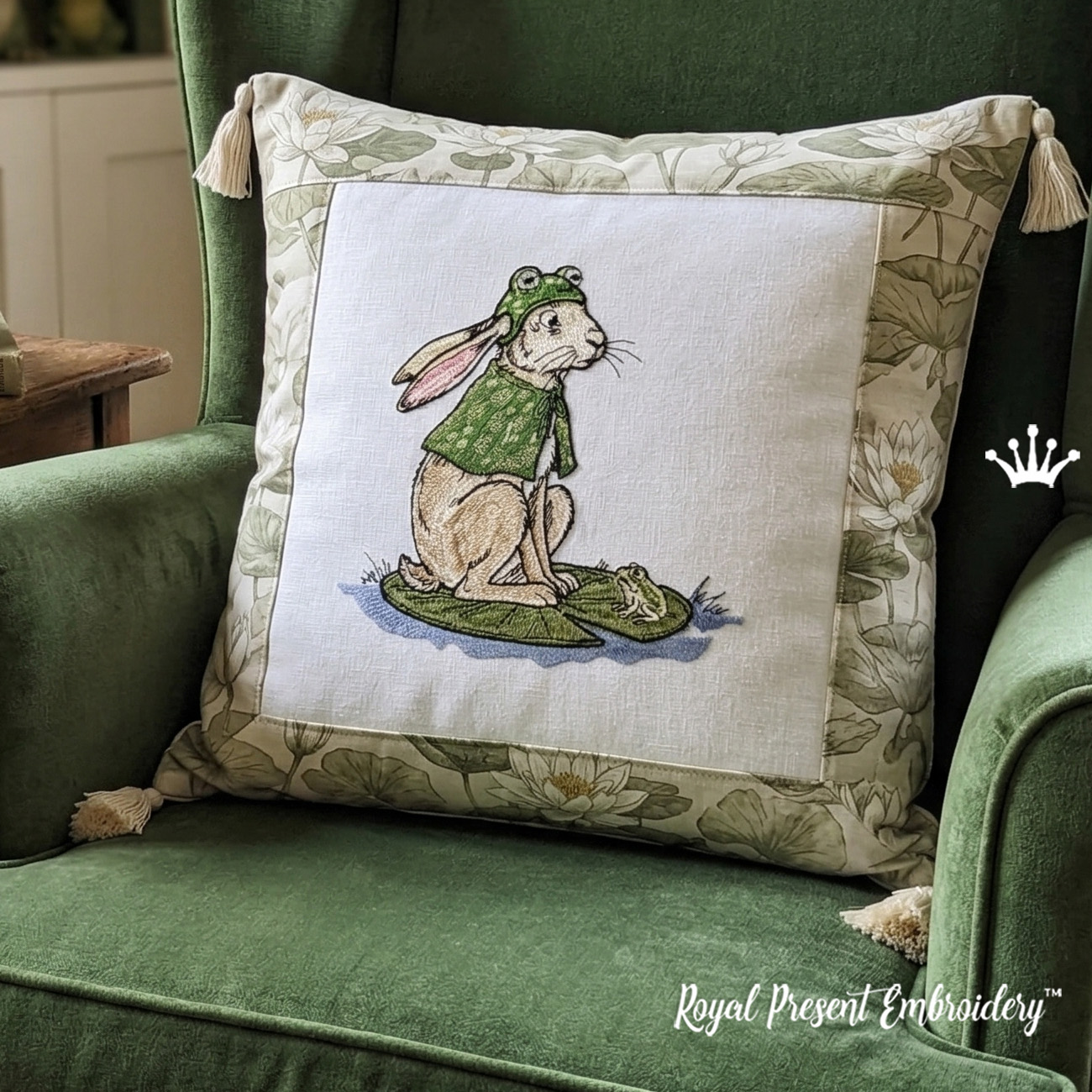 Bunny in a frog costume Bunny in a frog costume |
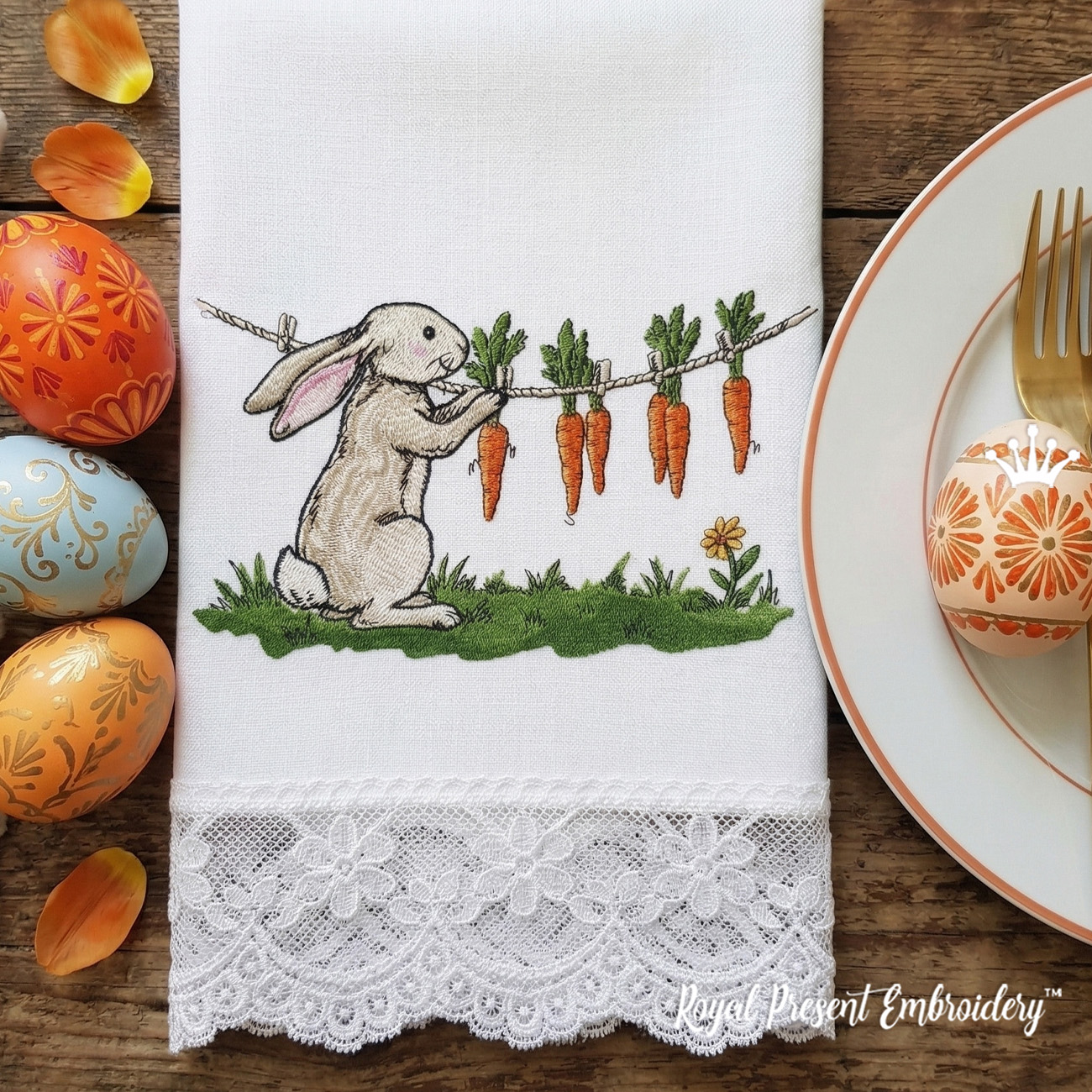 Bunny hangs carrots Bunny hangs carrots |
 Bunny with a frog Bunny with a frog |
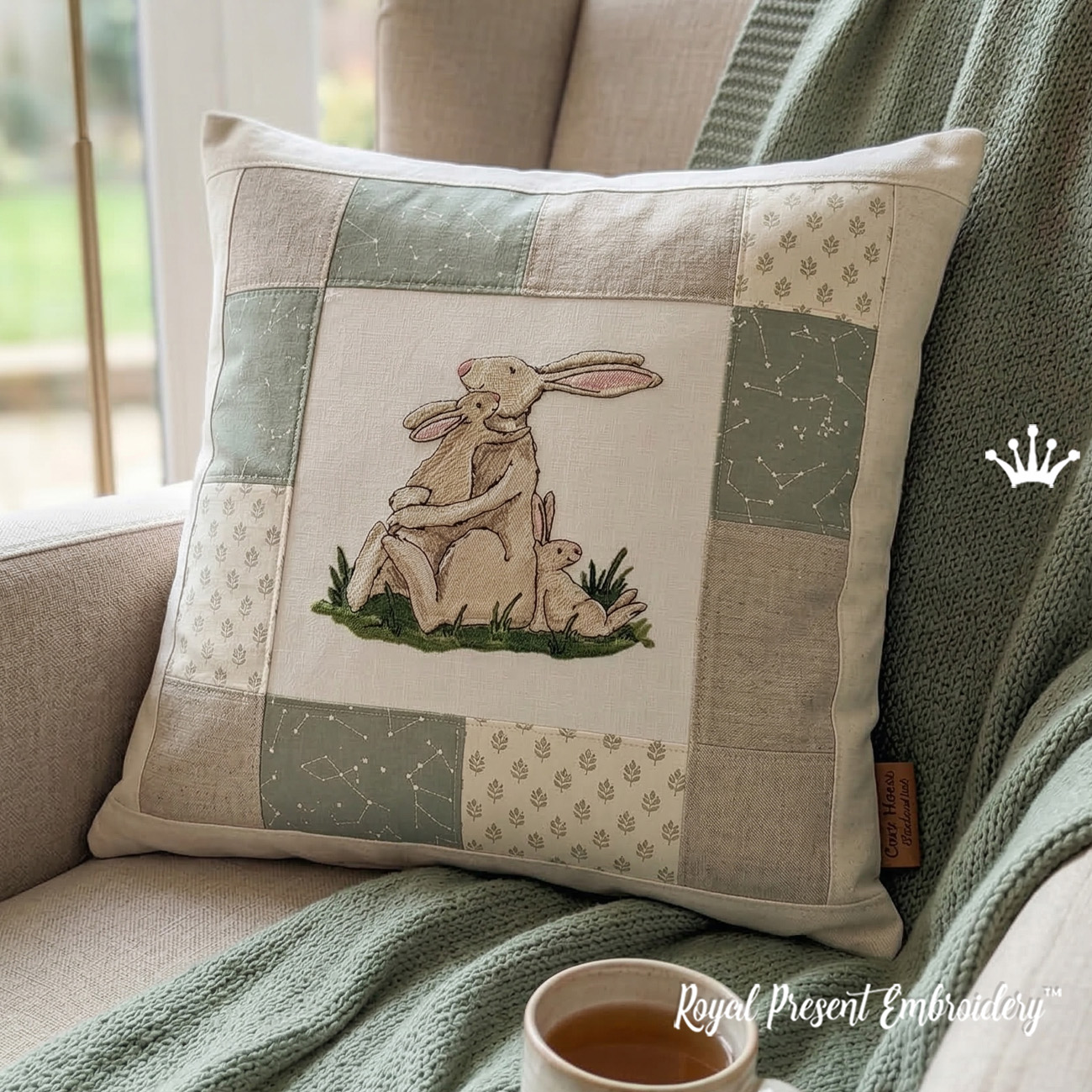 Mama bunny with baby bunnies Mama bunny with baby bunnies |
Madeira Classic 40 thread chart
The codes and swatches correspond to the supplied color map.
| Madeira Classic 40, 1260 | Madeira Classic 40, 1136 | ||
| Madeira Classic 40, 1338 | Madeira Classic 40, 1128 | ||
| Madeira Classic 40, 1021 | Madeira Classic 40, 1172 | ||
| Madeira Classic 40, 1130 | Madeira Classic 40, 1142 | ||
| Madeira Classic 40, 1071 | Madeira Classic 40, 1113 | ||
| Madeira Classic 40, 1072 | Madeira Classic 40, 1292 | ||
| Madeira Classic 40, 1006 | Madeira Classic 40, 1193 |
Placement and stabilization
The scene is vertical. Print a template at 100% scale or mark the vertical center line before hooping. Run a trace before stitching so the grass at the base and the side leaves do not land on a seam, pocket, or finished edge.
For stable woven cotton or linen, start with a medium tear-away backing such as Madeira Cotton Soft. A practical starting point for total backing support is fabric weight divided by 3: 180 g/m², about 5.3 oz/yd², of fabric needs roughly 60 g/m², about 1.8 oz/yd², of support. For loosely woven linen, canvas, a frequently worn garment, or a panel that shifts in the hoop, choose a medium cut-away backing such as Gunold Stiffy 2040 Cut Away. Prewash and press linen; apply a light coat of Gunold KK 100 to the backing, never to the front of the fabric.
Frequently asked questions
How can I stitch on terry cloth or fleece without losing the bunny's face and leaves?
Use a medium cut-away backing such as Gunold Stiffy 2040 Cut Away under the item and Sulky Solvy water-soluble topping on top. Hoop all three layers together without stretching the pile. The topping keeps the small facial and leaf stitches above the surface; remove excess after stitching and dissolve any remaining residue with water according to the product directions.
What prevents puckering around the dense pumpkin fill?
Prewash cotton or linen that may shrink, dry it, and press it flat. Hoop the backing and fabric together without pulling either layer taut. The support must match the fabric: a stable woven textile can use Madeira Cotton Soft, while loose linen or a moving bag panel needs cut-away support. Do a small test on the same material before the finished item.
Why use temporary spray adhesive for this design?
The pumpkin has a dense filled area, while the face and leaf outlines are narrow. A very light coat of Gunold KK 100 on the backing helps the fabric and backing move as one layer when the machine passes from fill to fine detail. Spray the backing away from the machine, then smooth the fabric onto it. Adhesive helps hold the layers together; it does not replace stabilizer or correct hooping.
Can I stitch this scene on knitwear?
Yes. Use a medium cut-away backing such as Gunold Stiffy 2040 Cut Away and hoop the knit so it lies flat in its natural state, never stretched. If the knit texture is raised enough to swallow the fine outline stitches, add Sulky Solvy topping. Support the rest of the garment during stitching so its weight does not pull on the hoop.

 Get Sign-In Link
 Login with Google
 Login with Facebook
 Login with Amazon
 Login with Paypal