Poinsettia Machine Embroidery Design – Lace Circle, 4 Sizes
By knowing the speed of your embroidery machine, you can find out how long it will take to embroider a design.
To use the embroidery calculator, click on the number of stitches in the product description.
This download includes one poinsettia machine embroidery design with a delicate lace-style circular ornament in four sizes. After purchase, you receive a ZIP archive containing files for an embroidery machine. This is not a finished embroidery, patch, freestanding lace file or in-the-hoop Christmas ornament.
Size: 158.6x155.5 mm (6.24x6.12"), Stitches: 45738
Size: 178.6x175.1 mm (7.03x6.89"), Stitches: 52238
Size: 198.6x194.7 mm (7.82x7.67"), Stitches: 59210
Size: 218.6x214.3 mm (8.61x8.44"), Stitches: 66357Formats: .dst, .jef, .pec, .vip, .hus, .pes, .exp, .sew, .dat, .vp3, xxx
Design specifications
| Included | 1 design in 4 original sizes |
|---|---|
| Design type | Multicolor flat embroidery on fabric; not ITH and not FSL |
| Thread palette | 6 Madeira Classic Rayon 40 colors, 9 color blocks |
| Recommended top thread | Madeira Classic Rayon 40 or another quality 40-weight machine embroidery thread |
Hoop compatibility
This is a large design. None of the four files fits a 130x180 mm (5x7") embroidery field. Rotating the design by 90 degrees does not help because both dimensions of the smallest file exceed 130 mm.
| Machine embroidery field | Files that fit |
|---|---|
| 130x180 mm (5x7") | None |
| 160x240 mm (6.3x9.45") | Only 158.6x155.5 mm (6.24x6.12") |
| 180x300 mm (7.09x11.81") | The first two sizes |
| 200x200 mm (8x8") | The first three sizes |
| 200x260 mm (8x10.24") or 200x300 mm (8x12") | The first three sizes |
| Field at least 218.6x214.3 mm | All four sizes |
When a file is close to the machine limit, the machine may reject it because a particular model reserves an internal safety margin. Before buying, compare both dimensions of the selected file with the maximum embroidery field stated by the machine manufacturer.
What the design depicts
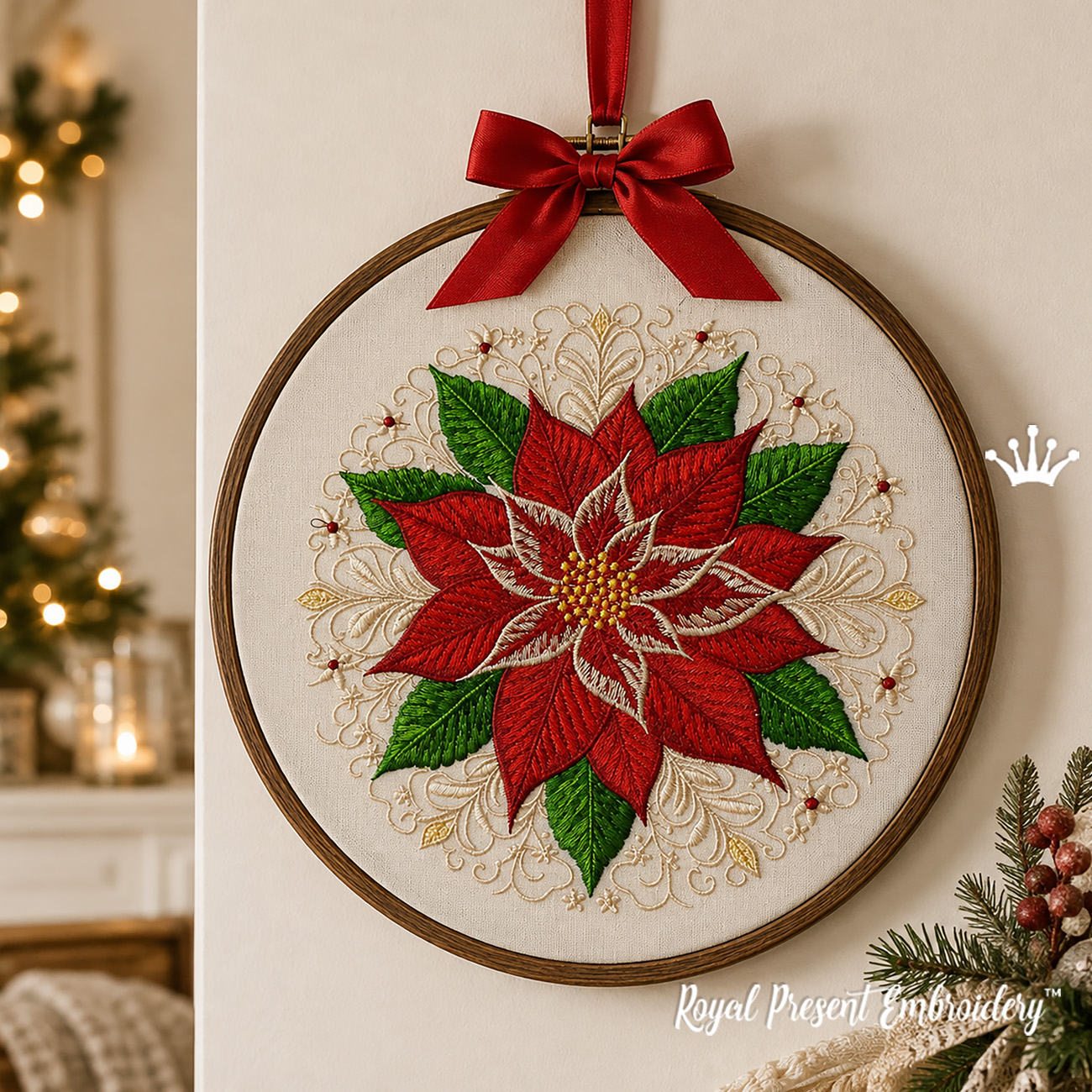
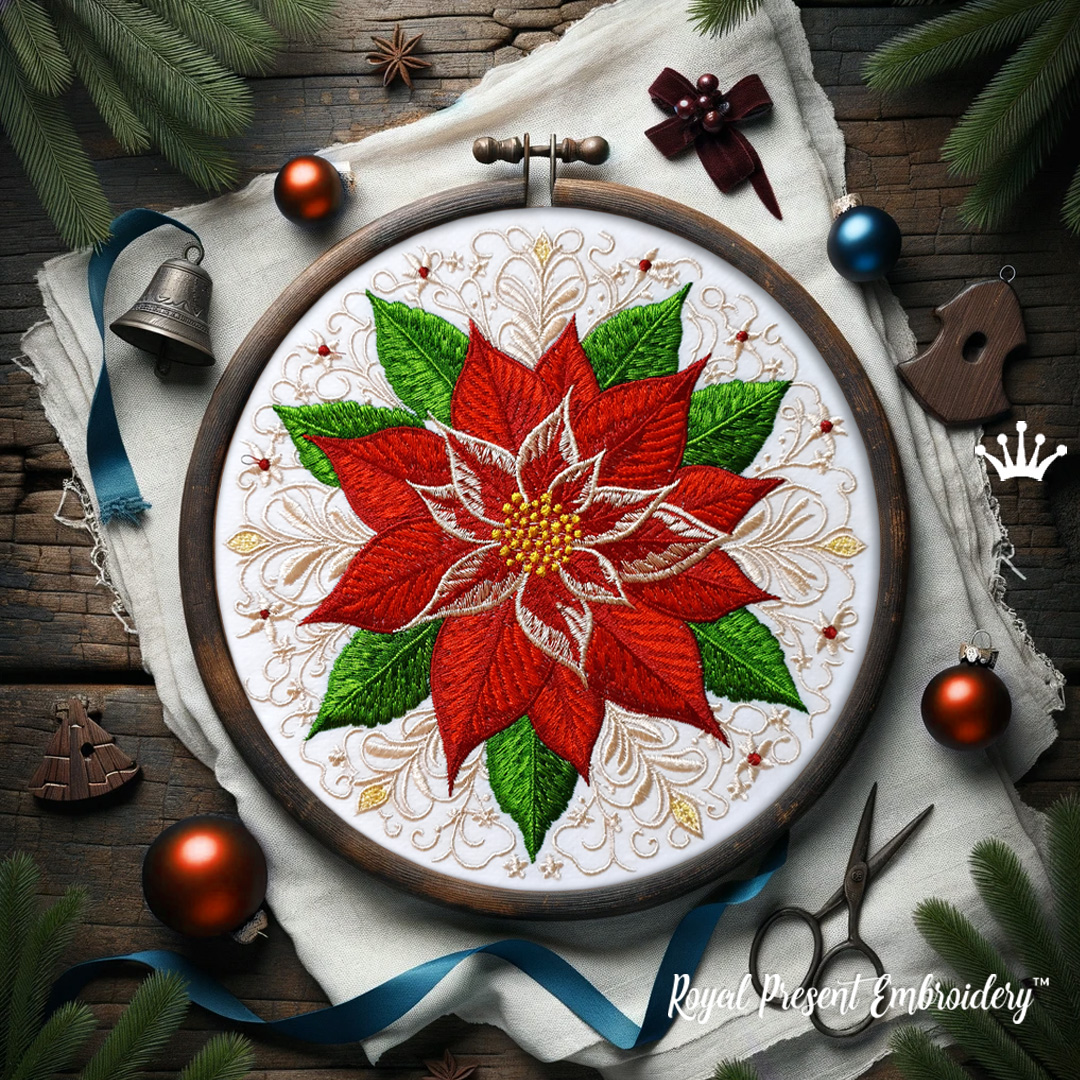
The composition centers on one large poinsettia. Red bracts are arranged in several layers, pale veins create depth, and green leaves form a second visual tier. Behind the flower is a circular openwork ornament made from scrolls, leaves and small floral elements. The light thread gives this background a lace-like appearance, but every stitch is supported by fabric.
The round format works best as a central motif on a decorative pillow, wall panel, table runner, large centerpiece mat, gift bag or framed textile artwork. It is too large for a standard dinner napkin. For a coordinated table set, place this motif on the central piece and use smaller poinsettia companion designs on napkins.
Madeira Classic Rayon 40 color chart
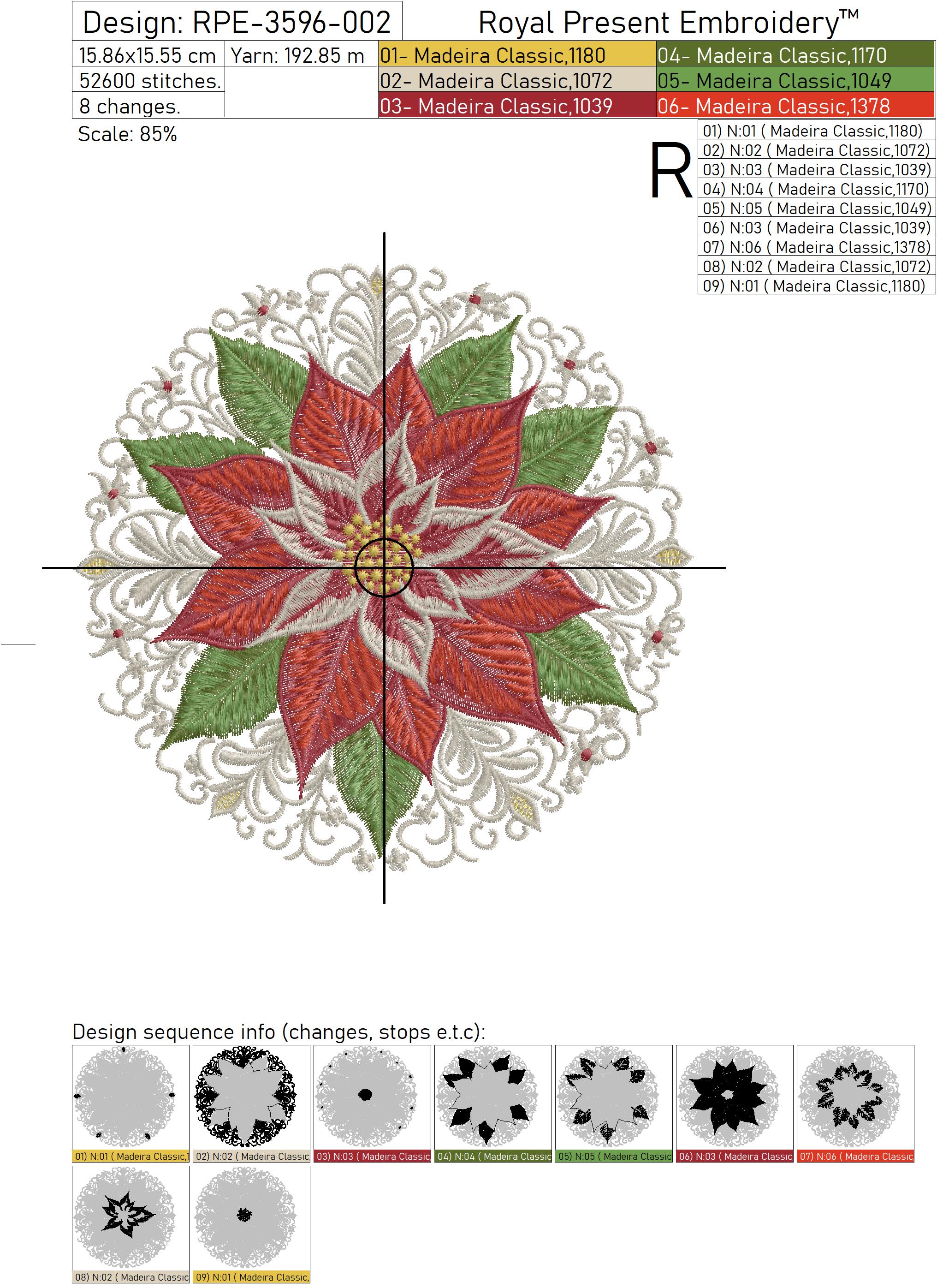
The RPE-3596-002 production chart contains six thread colors. The squares are approximate screen references: rayon sheen, monitor settings and dye-lot variation affect the visible shade. Match replacement thread primarily by the Madeira number.
| Color | Number | Madeira name | Design element | |
|---|---|---|---|---|
|
|
1180 | Daffodil Yellow | Poinsettia center and small golden accents in the openwork circle | |
|
|
1072 | Coconut Cream | Pale openwork circle, veins and highlights on the inner bracts | |
|
|
1039 | Brick Red | Dark red sections, outlines, shadows and small red details | |
|
|
1170 | Fern Green | Dark foliage, leaf edges, veins and shaded areas | |
|
|
1049 | Lime Green | Main light-green leaf fills | |
|
|
1378 | Paprika Red | Bright red-orange fills on the poinsettia bracts |
Color sequence
9 color blocks: 1180 → 1072 → 1039 → 1170 → 1049 → 1039 → 1378 → 1072 → 1180.
Colors 1039, 1072 and 1180 return after other blocks because they stitch separate layers of the composition. Do not enable automatic color merging. Changing the sequence may alter the intended overlap between pale veins, red bracts and the small details of the openwork background.
Madeira stabilizers for home embroidery machines
Because the design is large and contains 45738–66357 stitches, choose the backing for the fabric and the selected file size. For stable woven linen, a practical test starting point is a total backing weight of about one-third of the fabric weight. This is a starting estimate, not a substitute for a full stitch-out on the project fabric.
| Fabric and project | Madeira stabilizer | Weight / thickness | How to use it |
|---|---|---|---|
| Firm 180–220 g/m² linen or cotton for a runner, panel or cushion cover | Madeira Cotton Soft 60, tear-away | 60 g/m² 1.77 oz/yd² |
Hoop one layer with the fabric. Test the third and fourth sizes before stitching the final project. |
| Loose or lightweight linen with shifting yarns | Madeira Cotton Stable, fusible tear-away | 50 g/m² 1.47 oz/yd² |
Fuse it to the wrong side without stretching, then hoop. If the large test puckers, add a second light layer of Cotton Soft 50 at a different fiber angle. |
| Firm décor fabric, canvas or bag fabric | Madeira Cotton Soft 80, tear-away | 80 g/m² 2.36 oz/yd² |
Use one layer underneath. Test whether the combination creates an overly stiff area around the embroidery. |
| Knit, sweatshirt fabric or stretch cushion cover | Madeira Super Strong, cut-away | 80 g/m² 2.36 oz/yd² |
Use one layer underneath and hoop without stretching the fabric. Trim the backing to 6–10 mm (0.24–0.39 in) around the stitched area. |
| Velvet, velour or terry cloth | Madeira Super Strong 80 underneath + Madeira Avalon Film on top | 80 g/m² / 2.36 oz/yd² 20 μm / 0.79 mil |
The film keeps pile below the pale and outline stitches. Test velvet for hoop marks before tightening the frame over the face of the fabric. |
| Organza for framed wall art | Madeira Avalon Ultra beneath the organza | 90 μm 3.54 mil |
Hoop the organza and film together, run a complete test and dissolve the film after embroidery. The organza remains as the permanent foundation; do not stitch this file on film alone. |
More help: choosing stabilizers for machine embroidery, tear-away stabilizers and Madeira Avalon water-soluble stabilizers.
Machine settings and embroidery technique
- fit a new 75/11 embroidery needle for linen, cotton and organza; begin with 80/12 on firm bag fabric;
- use machine-embroidery bobbin thread such as Madeira Bobbinfil 70 in a color suitable for the reverse of the project;
- mark the vertical and horizontal axes on the fabric and align them with the hoop center;
- hoop the fabric and stabilizer together; floating is less reliable for a large circular design that depends on accurate registration;
- start at 500–650 stitches per minute and reduce speed on loose linen, organza and long openwork outlines;
- after the first pale scrolls, pause and check that the circle is not pulling inward and that the fabric has not shifted on the backing;
- keep all nine color blocks in order and do not merge repeated thread numbers automatically;
- complete a full test of the chosen size using the same fabric, needle, thread and stabilizer planned for the final item.
Practical tips for a clean circular ornament
- Test placement with a paper template. Print the selected file boundary at 100%, cut out the rectangle and place it on the item. This shows whether the ornament will sit too close to a seam, zipper or cushion edge.
- Do not rely only on the hoop name. A hoop sold as 200x200 mm may have a slightly smaller usable field. The third file is 198.6 mm wide and leaves only 1.4 mm total clearance.
- Choose a display hoop with breathing room. For 218.6x214.3 mm embroidery, a hand-embroidery hoop with a 240–250 mm inner diameter usually frames the openwork edge more cleanly than a 220 mm hoop.
- Remove tear-away in small sections from the edge toward the center. Pulling away one large sheet can distort the narrow openwork scrolls.
- Use bobbin thread close to Coconut Cream 1072 on pale fabric. It gives the reverse of the openwork circle a calmer appearance, especially on organza or double-sided décor.
Where to use the design
- the center of a decorative Christmas pillow or cushion cover;
- a table runner, large centerpiece mat or central tablecloth insert;
- a round hand-embroidery hoop as framed Christmas wall art;
- the front of a firm cotton gift bag or Christmas sack;
- a holiday basket, box or pillow cover;
- a velvet interior panel;
- the center block of a Christmas quilt or textile wall hanging.
For framed hoop art, press the reverse over a soft towel after stitching so the iron does not flatten the raised satin stitches. Washing, drying and pressing rules for rayon, polyester, metallic thread and delicate fabrics are explained in the embroidery care guide.
Download and license
After purchase, download and unzip the archive, then transfer only the supported machine-format file to your embroidery machine. The machine cannot read the ZIP archive itself. Each of the four sizes is supplied as a separate file; do not resize it in the machine menu without stitch recalculation.
You may sell finished physical items embroidered with this design in small craft-business quantities. You may not copy, share, exchange, publish, include or resell the digital files in another digital collection. See the Royal Present Embroidery license and terms for full conditions.
Frequently asked questions
Is this a finished Christmas ornament or an ITH design?
No. This is a digital file for flat machine embroidery on fabric. The circular composition is decorative, but it does not produce a freestanding ornament and contains no in-the-hoop assembly steps.
Will this design fit a 130x180 mm hoop?
No. The smallest file is 158.6x155.5 mm (6.24x6.12"), so both of its dimensions exceed the 130 mm side of a 130x180 mm embroidery field. Rotating the design does not change that.
Which sizes fit a 200x200 mm embroidery field?
The first three files fit mathematically, including 198.6x194.7 mm (7.82x7.67"). However, that third file leaves only 1.4 mm (0.06") total width clearance. Confirm the usable field of your exact machine model before purchase.
Can I stitch the design on organza and frame it in a hand hoop?
Yes, after a complete test. Hoop stable organza with Madeira Avalon Ultra 90 μm, stitch the design and dissolve the film according to its instructions. The organza must remain beneath the stitches because this file was not digitized as freestanding lace.
Which stabilizer should I use for a linen cushion cover?
For stable 180–220 g/m² linen, start with one layer of Madeira Cotton Soft 60 at 60 g/m² (1.77 oz/yd²). For loose linen, use fusible Madeira Cotton Stable 50. If a complete test of the third or fourth size puckers, add a second light layer instead of increasing support without testing.
Design author: Ludmila Konovalova, Royal Present Embroidery.

 Get Sign-In Link
 Login with Google
 Login with Facebook
 Login with Amazon
 Login with Paypal