Madeira Cotton Fix is a self-adhesive tear-away stabilizer for machine embroidery. It is useful when fabric is difficult to hoop, too delicate for strong hoop pressure, too small for normal hooping, or already sewn into a finished item.
Quick answer: Madeira Cotton Fix helps hold fabric in place without traditional hooping. It is especially helpful for machine embroidery on T-shirts, knitwear, velvet, leather, pockets, collars, cuffs, napkins, towels and ready-made garments.
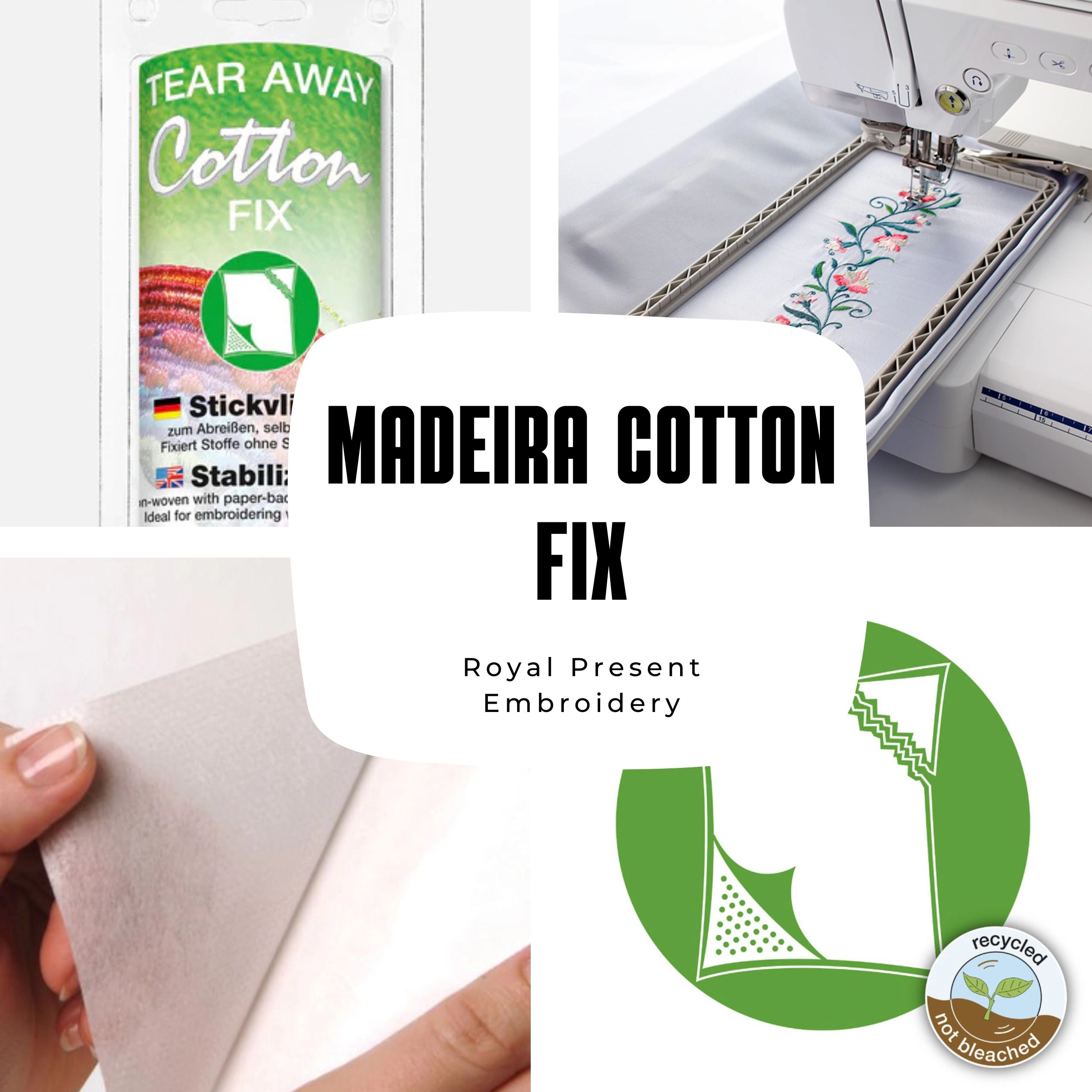
Madeira Cotton Fix is a self-adhesive tear-away stabilizer used for machine embroidery on fabrics that are hard to hoop.
What is Madeira Cotton Fix?
Madeira Cotton Fix is a non-woven tear-away stabilizer with a paper backing and an adhesive layer. The sticky surface holds the fabric in place during embroidery, so the fabric does not need to be hooped in the usual way.
This makes it useful for delicate, stretchy, textured or already finished items where hoop marks, stretching or poor placement can become a problem.
When should you use Madeira Cotton Fix?
Use Madeira Cotton Fix when the fabric or item is difficult to hoop, when the embroidery area is small, or when you want better control over placement.
| Use case | Can you use Cotton Fix? | Important note |
|---|---|---|
| T-shirts and knitwear | Yes | Place the fabric gently to avoid stretching before embroidery. |
| Pockets | Yes | Useful when the pocket cannot be hooped normally. |
| Collars and cuffs | Yes | Good for small and awkward embroidery areas. |
| Velvet | Yes | Helps avoid visible hoop marks on the fabric surface. |
| Leather or faux leather | Yes | A good option when hoop pressure may leave marks. |
| Terry towels | Yes, with topping | Use water-soluble topping on top and Cotton Fix underneath. |
| Very dense embroidery | Maybe | Dense designs may need stronger stabilization. |
| Freestanding lace | No | Use water-soluble stabilizer instead. |
How to use Madeira Cotton Fix step by step
- Cut a piece of Madeira Cotton Fix slightly larger than the embroidery area.
- Hoop the stabilizer with the paper side facing up.
- Score the paper backing carefully inside the hoop area.
- Peel away the paper to expose the sticky surface.
- Place the fabric on the adhesive area and smooth it down gently.
- Check that the fabric is flat and not stretched.
- Embroider the design.
- After embroidery, remove the item from the hoop.
- Gently tear away the excess stabilizer from the back.
Two ways to use Cotton Fix
Method 1: Hoop the stabilizer only
This is the most common method. Hoop only the stabilizer, remove the paper backing from the embroidery area, and place the fabric on the sticky surface. This method is useful for ready-made garments, pockets, collars, cuffs and small areas that cannot be hooped easily.
Method 2: Stick Cotton Fix to the wrong side of the fabric
You can also attach Cotton Fix directly to the wrong side of the fabric and then hoop the fabric together with the stabilizer. This method can work well when the fabric needs extra support but can still be hooped safely.
Cotton Fix vs other stabilizers
| Stabilizer type | Best for | Main difference |
|---|---|---|
| Cotton Fix | Hard-to-hoop fabrics and finished items | Self-adhesive and tear-away. |
| Tear-away stabilizer | Stable woven fabrics | Hooped together with the fabric and torn away after stitching. |
| Cut-away stabilizer | Knits, stretch fabrics and dense embroidery | Remains behind the embroidery for long-term support. |
| Water-soluble topping | Towels, fleece and fluffy fabrics | Used on top of the fabric to keep stitches from sinking. |
| Water-soluble stabilizer | Freestanding lace and projects where backing must disappear | Dissolves in water after embroidery. |
Common mistakes when using Madeira Cotton Fix
- Stretching knit fabric before embroidery. Place the fabric naturally on the sticky surface. Do not pull it.
- Using it for very heavy designs without enough support. Dense embroidery may need cut-away stabilizer or an additional stabilizer layer.
- Skipping water-soluble topping on towels. For terry cloth and fluffy fabrics, use topping on the surface.
- Using too small a stabilizer piece. Leave enough margin around the embroidery area.
- Removing the stabilizer too aggressively. Tear it away slowly while supporting the stitches with your fingers.
How much Madeira Cotton Fix do you need?
To estimate stabilizer usage, add a safety margin around the embroidery design. A simple formula is:
The extra 3 cm gives you about 1.5 cm of margin on each side. This helps keep the embroidery area secure.
Example: if your design is 10 × 10 cm and you want to embroider 50 pieces:
If one roll is 30 cm × 3 m, the total area is 9,000 cm², so one roll should be enough for this example.
Best embroidery projects for Madeira Cotton Fix
Madeira Cotton Fix is especially useful for embroidery projects where accurate placement matters and traditional hooping is uncomfortable or risky.
- Monograms on shirt pockets
- Small embroidery on collars and cuffs
- Embroidery on napkin corners
- Decorative embroidery on towels
- Small designs on T-shirts and knitwear
- Embroidery on velvet, leather and faux leather
- Ready-made garments and accessories
For projects with fluffy fabric, such as towels or fleece, combine Cotton Fix underneath with a water-soluble topping on top. This helps keep the stitches clear and prevents them from sinking into the fabric pile.
Useful Royal Present embroidery guides
These guides can help you choose the right stabilizer, file, size and embroidery method for your project:
- Embroidery Machine File Formats
- Embroidery Machine Size and Stitch Limits
- How to Unzip Embroidery Folders
- How to Use a Color Chart for Your Machine Embroidery Design Project
- Machine Embroidery: Stitch Density, Fabric and Stabilizer Balance
Frequently Asked Questions
Is Madeira Cotton Fix good for machine embroidery?
Yes. Madeira Cotton Fix is useful for machine embroidery when the fabric is difficult to hoop, delicate, small, stretchy or already part of a finished garment.
Is Madeira Cotton Fix tear-away?
Yes. Cotton Fix is a tear-away stabilizer. After embroidery, the excess stabilizer can be gently removed from the back of the fabric.
Can I use Cotton Fix for towels?
Yes, but for terry towels you should also use a water-soluble topping on top of the fabric. The topping helps keep the embroidery stitches from sinking into the towel pile.
Can I use Cotton Fix for T-shirts?
Yes, but place the T-shirt on the sticky surface without stretching it. For dense embroidery or very stretchy fabric, additional cut-away stabilizer may be safer.
Can Cotton Fix replace cut-away stabilizer?
Not always. Cotton Fix is helpful for placement and hooping problems, but cut-away stabilizer is usually better for stretchy fabrics, heavy designs and embroidery that needs long-term support.
Can I use Cotton Fix for freestanding lace?
No. Freestanding lace should be embroidered on water-soluble stabilizer, not on Cotton Fix.
Why does fabric still shift on Cotton Fix?
Fabric can shift if the stabilizer piece is too small, the adhesive is old, the fabric was stretched before embroidery, or the design is too dense for this stabilization method.
How do I remove Cotton Fix after embroidery?
Hold the embroidered area with your fingers and gently tear away the excess stabilizer from the back. Do not pull hard across delicate stitches.
Final thoughts
Madeira Cotton Fix is a practical stabilizer for embroidery projects where normal hooping is difficult or risky. It helps with placement, reduces fabric movement and makes it easier to embroider small areas, delicate fabrics and ready-made garments.
For the best result, always match the stabilizer to the fabric, embroidery density, hoop size and final use of the item. Good stabilization is not a small technical detail — it is what keeps embroidery clean, flat and professional.

Author: Ludmila Konovalova
My name is Ludmila Konovalova, and I lead Royal Present Embroidery. Embroidery for me is more than a profession; it is a legacy of my Ukrainian and Bulgarian heritage, where every woman in my family was a virtuoso in cross-stitch and smooth stitching. This art, passed down through generations, is part of my soul and a symbol of national pride.
Date: 11.01.2026

 Get Sign-In Link
 Login with Google
 Login with Facebook
 Login with Amazon
 Login with Paypal